How to Use AI in Vet Med Without Increasing Clinical, Legal, or Trust Risk


In 2024, Digitail and AAHA asked 3,968 veterinary professionals about AI. Nearly 40% were already using it. The thing they wanted most, ahead of everything else, was confidence in what it produced.
Adoption moved faster than the habits that produce that confidence, and closing the gap is what people mean by responsible AI in veterinary medicine: running AI tools under defined human oversight. Every output that reaches a patient, a record, or a client passes through a named professional who can accept it, adjust it, or set it aside. The practice can then show that the review happened.
What does responsible AI in veterinary medicine actually mean?
Regulators in different countries have been working on this separately, and they’ve arrived at strikingly similar places.
In the UK, the RCVS and Digital Practice convened the Veterinary AI Transparency Alliance, whose draft framework sets out 23 principles covering risk, human oversight, data storage and usage, and the effect of AI on client choice and consent. It took 18 months and involved developers, practices, regulators, insurers, educators, and animal owners. RCVS chief executive Lizzie Lockett framed the goal as adopting these tools “with requisite caution” while keeping professional judgment central.
In Canada, the Alberta Veterinary Medical Association published a formal professional standard in January 2026 saying much the same thing: confirm AI recommendations before you diagnose or treat, don’t rest a decision on AI alone, and review AI-generated medical records before they go into the file.
In the US, the AVMA has convened a Task Force on Emerging Technologies and Innovation to do comparable work.
Four principles recur:
- Keep a qualified human accountable for the output
- Be transparent with clients
- Know where your data goes
- Verify that the workflow is still being followed
Where does AI in veterinary practice need human oversight?
Veterinary AI governance isn’t about using AI less. It’s about knowing whose name is on the result.
| AI task | What you’re confirming | Whose job |
| SOAP dictation | Drug, dose, laterality, and plan read exactly as you intended | Attending DVM |
| Record summaries | The summary carries the details that matter for this case | Attending DVM |
| Discharge notes | The client leaves with instructions you’d stand behind | DVM or credentialed tech |
| Triage and phone agents | Urgency was handled the way your protocol intends, with a human fallback | Practice manager |
| Voice to invoice | Every charge on the bill matches what you discussed | CSR and practice manager |
| Imaging support | Your read, with the output serving as a second opinion | Attending DVM |
| Client-facing chat | Answers stay inside the scope you set | Practice manager |
What are the consent rules for AI scribes, and what should you tell clients?
Consent rules vary enormously by country, and this is the question practices most often skip. Some jurisdictions need consent from only one person in the conversation, which is you; others require it from everyone present; a few have written rules specific to AI documentation tools, and more are drafting them now.
Two things do hold everywhere. A tool listening in your consulting room counts as a recording device whether or not it keeps the audio afterward, and your existing consent form almost certainly doesn’t cover it, because most were written when a person typed the notes. Your veterinary regulator and your national data protection authority are the two places to start, and this is worth a conversation with someone who knows your local law before you roll anything out.
Whatever your jurisdiction says, these are the eight things to settle before you switch anything on.
| What to settle | Why it matters |
| Whether consent is needed from everyone present, or only from you | Decides whether a notice is enough or you need an explicit yes |
| Whether verbal notice satisfies your regulator, or written consent is required | Changes your intake paperwork, not just what you say in the room |
| Whether your current consent form covers audio recording | Most cover documentation and record sharing, not recording or third-party processing |
| What happens when a client declines | An option you can’t actually deliver does more damage than never offering one |
| Where audio and transcripts are stored, and for how long | Data protection law governs this separately from consent |
| Whether a client can ask for a recording to be deleted | Worth knowing the answer before someone asks it |
| Who raises it, and at what point in the visit | Consent that depends on somebody remembering won’t hold |
| Whether reception signage is expected in your jurisdiction | Some regulators treat notice and consent as two different obligations |
In the room, most of it comes down to fifteen seconds at the start:
“I use an AI tool that listens during the appointment and drafts my notes. I go through everything before it goes in record. If you’d rather I didn’t, just say so and I’ll write them up myself.“
That does three jobs at once. It says what the tool is for, it puts you on the hook for the result, and it gives the client a way out.
What to look for in an AI for veterinary practices?
Veterinary AI compliance holds up better when it lives in the software instead of depending on everyone remembering. When you’re comparing platforms, look at role-based permissions, audit logs that cover AI activity, review built into the workflow rather than bolted on afterward, and output you can adjust rather than only accept or reject.
Tails AI builds these into Digitail. It works inside the record rather than alongside it. You open it from any patient page, ask in ordinary clinical language, and it answers from that patient’s file. It handles one patient at a time with no cross-knowledge of others, and Digitail publishes exactly which fields it can read: patient details and weights, owner and contact records, appointments, past records and diagnoses, medications and prescriptions, diets, preventive treatments, client communications, invoices, tasks, and uploaded images.
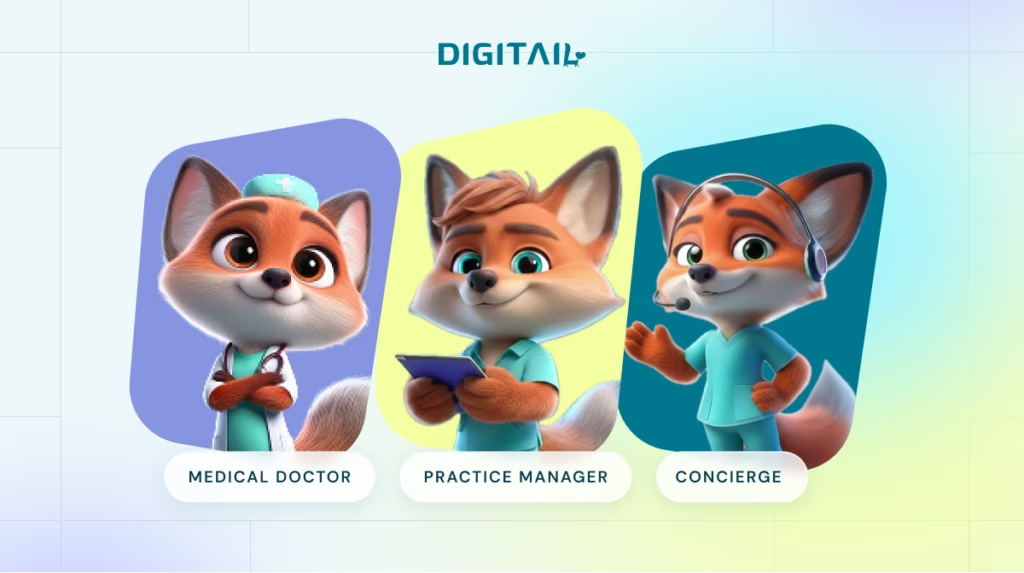
The capabilities divide by role. Tails Concierge covers front-desk work, including patient intake, triage, booking, follow-ups, prescription refills, and discharge notes. Tails Medical covers the clinical side: dictation that transcribes a visit and structures it into SOAP format, SOAP Verification, patient summaries before you walk into the room, voice to invoice, and analysis of uploaded documents and images. Tails Practice Manager handles the back office, from products and services to commissions and analytics.
The pattern is the same across all three. Tails drafts, and you commit. Dictation produces a note you review, adjust, and sync to the record yourself. SOAP Verification reads the drafted note against the patient’s history, flags dosages that don’t suit the animal’s weight and profile along with contraindications and anything inconsistent with the file, and then leaves the decision to you. Access is set per role, and a thumbs-down on any answer sends it back to Digitail.
The documentation states the limit plainly: Tails doesn’t replace a human being, and final decisions on patient care stay with the professional.
For teams still learning how to work with AI, knowing what to ask can be just as important as choosing the right tool. Digitail has created a free library of more than 100 ready-to-use prompts for veterinary practices, covering clinical, client communication, and operational workflows.
Explore 100+ AI Prompts for Veterinary Practices
Use AI technology to advance the way you practice and deliver care
Your ultimate AI-Powered Veterinary Assistant built right into your practice management software!