
The Veterinary AI Maturity Model: How Ready Is Your Practice for AI?


Artificial intelligence is becoming part of everyday veterinary practice. AI scribes help veterinarians complete medical records, automated communication tools handle routine client messages, and AI-powered diagnostics support clinical decisions.
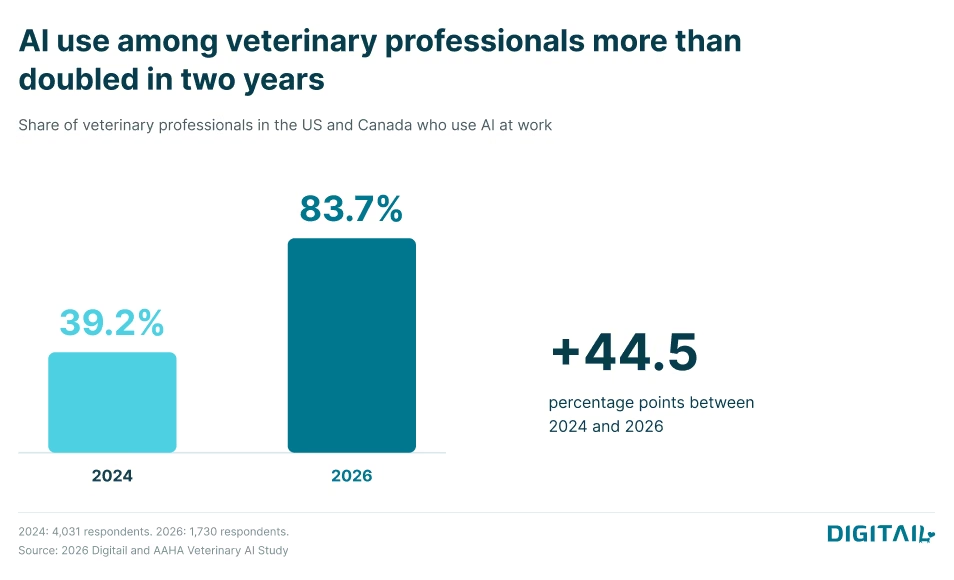
According to the 2026 Veterinary AI Study by Digitail and the Animal Hospital Association (AAHA), 83.7% of veterinary professionals now use AI, compared with just 39.2% in 2024.
But while AI adoption has grown rapidly, the way practices use it hasn’t always kept pace.
Many clinics are still experimenting with AI tools without a clear plan, someone responsible for managing AI, or consistent staff training. Some use AI for just a handful of tasks, while others struggle with disconnected systems and extra manual work.
The result? Two practices can use similar AI tools and see very different benefits.
The 2026 research found that veterinary practices with the highest AI maturity reported roughly six times as many positive business outcomes as those with the lowest maturity.
So, what makes the difference? And how can you tell whether your practice is ready to get more value from AI?
AI adoption is growing, but many practices still lack a clear strategy
Veterinary professionals are finding plenty of reasons to use AI. In the 2026 Digitail and AAHA study, 44.3% of AI-using respondents reported more time for patient care or higher patient throughput, while 32% reported improvements in client retention or satisfaction.
Yet the research also found that AI is often introduced without much planning.
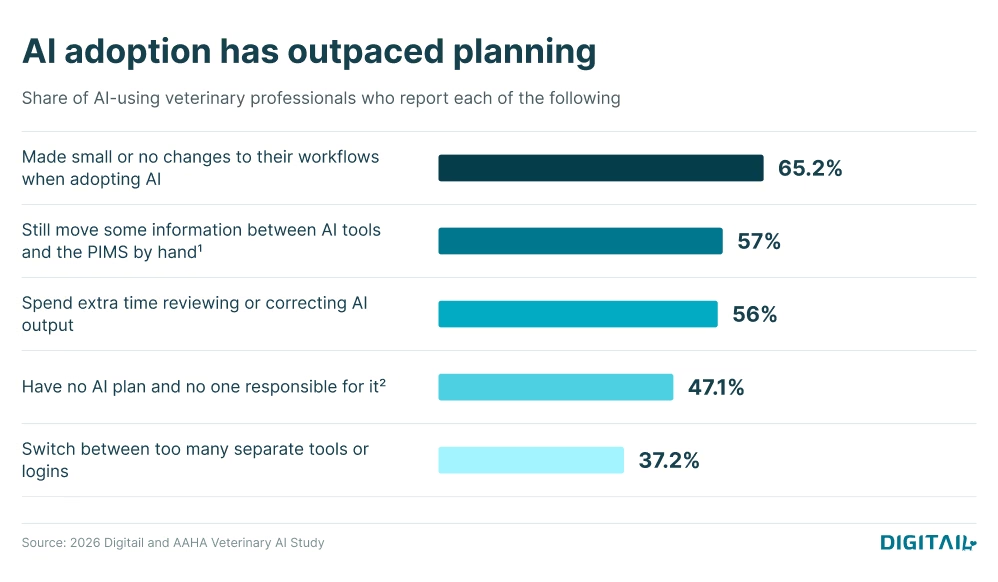
Nearly half of AI-using respondents reported that their practices were experimenting without a clear strategy or a designated owner. And 65.2% said their practices had made only small adjustments to existing workflows or hadn’t changed them at all when adopting AI.
Other challenges are just as common:
- 57% still transfer at least some information manually between AI tools and their practice management system (PIMS).
- 56% spend extra time reviewing or correcting AI-generated output.
- 37.2% experience friction from switching between too many separate tools or logins.
Consider a veterinary practice using AI for clinical documentation. The tool generates notes quickly, but the veterinarian still needs to review them, copy information into the PIMS, and complete other documentation steps manually.
The AI tool works, but the overall workflow may still be inefficient.
Another practice might use a similar tool but have it connected to the PIMS, with a clear process for reviewing and finalizing records. The team spends less time moving information between systems and more time caring for patients.
Both practices have adopted AI. The difference lies in how they’ve incorporated it into daily work.
Why do some veterinary practices see better results from AI?
The 2026 Digitail and AAHA study found that the benefits of AI depend on more than how many tools a practice uses.
To better understand these differences, the research introduced the Veterinary AI Maturity Model, adapted from the peer-reviewed Healthcare AI Governance Readiness Assessment (HAIRA) framework, to measure how deliberately practices adopt, manage, and integrate AI into their operations.
The index evaluates six areas of AI maturity, including strategy, oversight, tool selection, workflow integration, adoption across the team, and organizational readiness.
Practices receive scores across four maturity levels, from Ad Hoc to Advanced.
The findings showed a strong relationship between AI maturity and the number of positive business outcomes reported by veterinary professionals.
| AI maturity level | Average positive business outcomes reported |
| Level 1: Ad Hoc | 0.64 |
| Level 2: Emerging | 1.67 |
| Level 3: Established | 2.42 |
| Level 4: Advanced | 4.05 |
At the lowest maturity level, 70.9% reported no measurable business impact from AI. At the two highest maturity levels, that figure dropped to roughly 11%.
More importantly, the relationship between AI maturity and positive business outcomes remained significant even after accounting for the number of AI applications respondents used.
In other words, simply adding more AI tools doesn’t explain why some practices report better results.
What matters is how practices select, support, and use those tools.
The research was based on self-reported experiences, so it doesn’t establish that higher maturity directly causes better outcomes. Still, the relationship suggests that practices may have a lot to gain from improving how they manage AI, not just expanding its use.
How do you know if your veterinary practice is ready for AI?
Your practice may already use AI every day, but that doesn’t necessarily mean it’s fully prepared to use it effectively.
AI readiness isn’t just about having modern software or a team that’s interested in new technology. It also involves the processes, people, and resources needed to make AI useful in daily operations.
To evaluate your practice’s AI readiness, start by considering a few questions.
1. Does your practice have a clear plan for using AI?
Think about why your clinic started using AI in the first place.
Was it to reduce documentation time, improve client communication, or help staff manage their workload? Or were tools added simply because they became available?
A more deliberate approach starts with identifying specific problems, setting priorities, and assigning someone to manage AI adoption.
2. Are your AI tools connected to existing workflows?
Look at how information moves between your AI tools and your PIMS.
Does your team still need to copy records, enter the same information multiple times, or switch between different platforms to complete a task?
Also consider whether your workflows have changed since introducing AI. Connecting software is useful, but practices may need to rethink how they complete certain tasks to fully benefit from automation.
3. Does your team know how to use AI responsibly?
AI tools need clear expectations around their use.
Does your practice have guidelines for handling patient and client information? Do employees know which AI tools are approved and when human review is required?
Are team members trained to recognize mistakes or limitations in AI-generated content?
Without these guidelines, staff may develop different habits, making AI use less consistent across the practice.
4. Is AI being used across the team?
AI adoption may begin with one veterinarian or practice manager who enjoys experimenting with new technology.
But is the rest of the team involved?
Consider whether AI is helping receptionists, veterinary technicians, assistants, and other staff members with their everyday responsibilities.
A practice may have useful AI capabilities available that most employees haven’t learned to use yet.
5. Can you measure the benefits of AI?
Finally, think about whether your practice can identify what has improved since adopting AI.
Are medical records completed faster? Has the administrative workload decreased? Are client communications more consistent?
If you aren’t tracking results, it’s hard to know which tools are worth keeping, where you need more training, or whether your approach should change.
These questions provide a useful starting point, but they don’t give you a complete picture of your practice’s AI maturity.
Assess your practice with the Veterinary AI Maturity Model
To help veterinary teams evaluate their readiness, Digitail developed a free Veterinary AI Maturity Model assessment, based on the framework used in the 2026 research with AAHA.
The assessment looks at six areas of your practice’s approach to AI and helps you understand how your clinic compares with industry benchmarks.
After answering a short questionnaire, you’ll receive:
- Your AI maturity level: See where your practice currently stands.
- Your six-dimension profile: Understand which areas are more developed and which need attention.
- Industry benchmarks: Compare your results with findings from the 2026 Digitail and AAHA study.
- A personalized roadmap: Get practical recommendations for improving AI readiness based on your answers.
The assessment is free and is designed for practice owners, managers, medical directors, and others familiar with how their clinic operates.
How can you improve AI readiness in your veterinary practice?
You don’t need to replace all your software or introduce several new AI tools to improve your practice’s AI maturity.
In many cases, the best place to start is with what you already have.
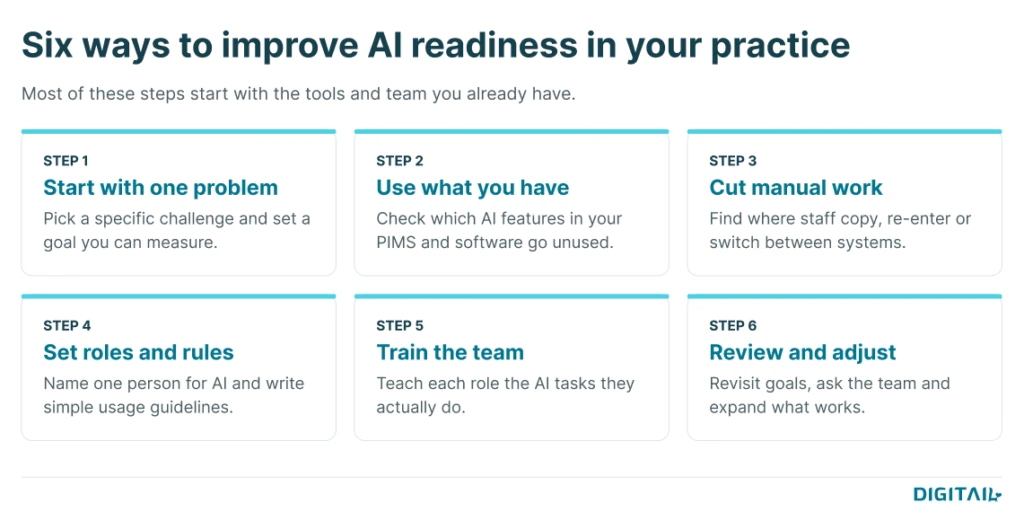
1. Start with one problem you want to solve
Before adding new AI tools, identify a specific challenge in your practice.
For example, if veterinarians regularly stay late to finish medical records, focus on reducing documentation time.
Set a clear goal and decide how you’ll measure progress. That makes it easier to evaluate whether AI is actually helping.
2. Make better use of your existing AI tools
Review the AI features already available through your PIMS and other software.
Are there capabilities your team isn’t using? Could some repetitive tasks be automated? Are separate tools performing similar functions?
You may discover that your practice can do more with its current technology before spending money on additional products.
3. Reduce manual work between systems
Look at where your team spends time copying information, switching platforms, or repeating tasks.
An AI tool that works independently may save time on one activity while creating extra work elsewhere.
Prioritise tools that are already within your existing systems and consider whether the workflow itself needs to change.
4. Establish clear responsibilities and guidelines
Decide who oversees AI adoption at your practice. This doesn’t need to be a dedicated position. A practice manager, medical director, or another team member can coordinate decisions and review results.
Create simple guidelines explaining which tools are approved, how data should be handled, and what staff need to review before using AI-generated information.
Clinical decisions and final medical records should always remain under appropriate veterinary professional oversight.
5. Invest in staff training
Even a useful AI tool can fall short if employees don’t understand how to use it.
Provide opportunities for staff to learn, ask questions, and share feedback. Focus on the tasks they perform rather than generic AI training.
For example, receptionists may benefit from learning how to work with AI-assisted client communication, while veterinarians may need guidance on reviewing AI-generated SOAP notes.
6. Review what’s working and what isn’t
AI adoption shouldn’t end when you introduce a new tool.
Revisit your goals, ask your team about their experiences, and review the results.
If a tool saves time, consider whether it could help elsewhere in the practice. If it’s creating extra work, identify what’s getting in the way before expanding its use.
Small, consistent improvements can help your practice build a more effective approach to AI over time.
What comes next for AI in veterinary practice?
AI is already part of daily work in most veterinary clinics, and its role is set to grow. In the 2026 Digitail and AAHA Veterinary AI Study, 79.8% of respondents said they expect AI to be part of most clinic workflows within five years.
Adoption alone doesn’t guarantee results, though. Practices that approach AI deliberately, support their teams, connect their tools, and review results regularly tend to report more benefits.
Making those decisions now gives your team a clearer foundation as AI takes on more of the work in veterinary medicine.
Less Admin Work, More Time for Veterinary Care
Digitail is an AI-native, cloud-based PIMS that brings your practice’s workflows together in one platform, helping your team spend less time on admin and more time on patient care.