5 Ways to Get New Clients for Your Vet Clinic


For most of the last decade, the new-client problem in veterinary medicine was too much demand. Pandemic-era pet adoption packed waiting rooms, and many clinics spent years just trying to keep up. That era is over.
The data now points the other way. Vetsource’s analysis of thousands of U.S. practices found patient visits down an average of 3.1% per practice in 2025, that’s the fourth straight year of decline. And the squeeze is tightest right at the top of the funnel, where it matters most for growth: the AVMA reports new clients are down 8.6% year over year. Veterinarians are feeling it, too, with more practices reporting softer-than-expected business and growing “white space” on their schedules.
Here’s the good news hidden in those numbers: demand hasn’t disappeared, it’s gotten conditional and competitive. Pet owners are still spending — they’re just slower to commit, more price-sensitive, and more likely to choose the clinic that’s easiest to find, easiest to trust, and easiest to book with. That means new-client acquisition can no longer be passive. The clinics winning right now are the ones being deliberate about it.
Below are five of the most effective ways to bring new clients through the door, with real examples from practices doing it well:
1. Get more 5-star Google reviews
When a pet owner searches “vet near me,” your Google Business Profile is your storefront. Star rating and review volume are among the biggest factors in whether someone clicks you or the clinic down the road, and they directly influence local search ranking. Reviews are the single highest-leverage acquisition asset most clinics already have and underuse.
The mistake clinics make is treating reviews as something that happens to them. In reality, review generation is a system: ask every happy client, ask at the right moment, and make it effortless to leave one. The best time is right after a positive visit, ideally with a direct link or QR code so there’s zero friction.
Real example: Shoreview Veterinary in Toronto, a brand-new practice, earned 60+ five-star Google reviews in its first six months open. Founder Dr. Nigel Skinner built efficient, tech-forward workflows from day one, automating documentation and personalizing client communication so the experience itself was worth talking about. The reviews were the visible result of an operation designed to make their clients happy, then making it easy for them to say so.

2. Run (and track) paid local ads
Organic reach only goes so far when the new-client pool is shrinking. Targeted Meta (Facebook/Instagram) and Google ads let you put your clinic in front of pet owners in your area, promote new-client offers, and fill that “white space” on the schedule.
A few campaigns punch above their weight for clinics. New-client welcome offers (a discounted first exam) give people a low-risk reason to switch. Geofenced Google ads catch the high-intent “vet near me” searches happening within a few miles of you. And simple Meta campaigns built around a specific service — dental month, senior wellness, new-puppy packages — tend to outperform generic “we’re a great clinic” awareness ads, because they give the viewer a concrete reason to click now.
The catch: most clinics run ads and have no idea whether they work. They can see clicks and impressions, but not whether those translated into booked appointments and real revenue. Even asking every new client “how did you hear about us?” at intake and logging the answer will tell you more than the ad platform’s dashboard ever will.
This is where tracking matters. The best approach is to connect your marketing data directly to appointment bookings. For example, clinics using Digitail can track appointments booked through their online booking calendar as conversion events in Google Analytics and Google Ads. That means you can see not only how much you spent on a campaign, but also how many appointment requests it generated and which channels are driving the strongest results. The goal is to connect spend to appointments, so you can invest more in what’s working and stop wasting budget on what isn’t.
3. Remove friction between “interested” and “booked”
You can generate all the awareness in the world, but if booking requires a phone call during business hours, you’ll leak prospective clients, especially younger pet owners who simply won’t call. Every barrier between interest and a confirmed appointment is a place where new clients quietly disappear.
The fix is 24/7 online booking and a client-facing app that lets people schedule, access records, and message your team on their own time. This is also where acquisition and retention blur together in the best way: the easier you make ongoing engagement, the more first-time clients become regulars.
Real example: Simmons Veterinary Clinic in Decatur, GA built from a standing start to 1,900+ dog visits and 1,000+ cat visits in its first year with no inherited client base. Today, 62% of pet parents use the Digitail app, and 1 in 4 appointments is booked directly through it. As a result, phone volume and front-desk friction drop, and clients self-serve. Dr. Chris Simmons is clear that this adoption rate didn’t happen by accident; it came from a deliberate, multi-touchpoint system (more on that below).
4. Win back lapsing clients
Here’s a stat to think about: the average time between veterinary visits grew to 85.8 days in 2023–2024, a 48% increase from just three years earlier. Clients aren’t necessarily leaving, they’re drifting. And a lapsed client who comes back is, functionally, a “new” client you acquire at a fraction of the cost of a stranger.
This is the most overlooked acquisition channel in the profession. Targeted reminders, wellness check-in campaigns, and automated outreach to patients who are overdue can pull significant volume back onto the calendar, especially when paired with the convenience of one-tap rebooking.
5. Turn happy clients into referrals
Word of mouth is the most trusted and lowest-cost way to acquire a new client: a prospect who arrives on a friend’s recommendation is already half-sold. But referrals rarely happen on their own. They’re earned by a visit good enough to mention, and then prompted by a clinic that actually asks.
The earning part is about experience: a calm, low-stress visit and a team that clearly cares is what makes a client want to tell someone. Dr. Chris Simmons built Simmons Veterinary Clinic to be a deliberately low-anxiety environment designed to make pets and owners feel at ease, and that kind of intentional experience is what turns a routine appointment into a recommendation.
The prompting part is where most clinics leave clients on the table. Don’t assume satisfied clients will spread the word unprompted. Make the ask part of the visit: a genuine “we’d love it if you told a friend,” a referral card at checkout, or a simple incentive like a discount on both the referrer’s and the new client’s next visit. The clinics that grow on word of mouth treat referrals as something they actively cultivate, not something they wait for.
Bonus: 5-step playbook for app adoption
Because the pet parent app underpins so much of modern acquisition and retention, it’s worth borrowing the exact system that got Simmons Vet to 62% adoption:
- Make it visible on your website: a prominent homepage call-to-action with a direct download link, so many clients arrive with the app already installed before they walk in the door.
- Use Google reviews to promote it: mention the app’s benefits in review responses to build trust and condition new clients to download it.
- Introduce it before the appointment: include a download link in appointment confirmations so check-in is faster and clients arrive familiar with it.
- Use the exam room: pull up a QR code at the end of the visit and invite clients to scan it while you close out the appointment.
- Get the whole team involved: when the front desk, techs, and vets all mention the app naturally at check-in, during the exam, and at checkout, it becomes part of the experience.
Read more: 5 Proven Strategies to Increase Adoption of a Pet Parent App
How it fits together
The clinics acquiring new clients in a softer market are running a connected system: great experiences generate reviews and referrals, paid campaigns extend reach, frictionless booking captures the demand, and automated outreach recovers the clients who drift. The reason an all-in-one platform matters here is that these pieces reinforce each other only when they share the same data. When your marketing, booking, communication, and reporting live in separate tools, attribution breaks and follow-up falls through the cracks. When they live together, acquisition becomes a flywheel you can actually measure and tune.
Acquire and keep more clients with Digitail
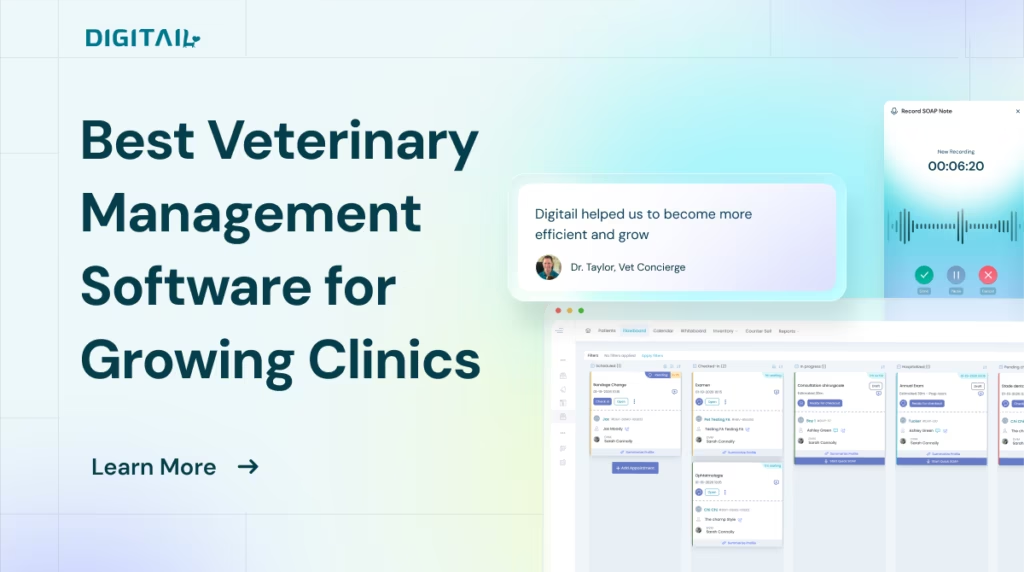
That’s exactly what Digitail is built to do. It’s a veterinary platform for your entire clinic that brings the acquisition flywheel into one system:
- a built-in marketing functionality for ad campaigns
- 24/7 online booking and a pet parent app so clients can schedule and self-serve
- automated reminders that win back lapsing patients
- real-time reporting
- integration tools to request and manage reviews
See the full feature set or book a demo to see how it fits your clinic.
Want to learn more about Digitail?

FAQ
It’s down, and it’s measurable. Patient visits fell an average of 3.1% per practice in 2025, continuing a multi-year decline, and new clients are down 8.6% year over year. The share of veterinarians reporting that business declined jumped from an expected 13% to an actual 29% over the course of 2025. The softness is real, but it’s driven by economic caution and price sensitivity, not by pet owners disappearing.
Mostly economics. Veterinary service costs have risen faster than general inflation, and price-sensitive owners respond by stretching the time between visits, skipping preventive care, or shopping around for products they once bought in-clinic. It’s less that people care less about their pets and more that they’re making more deliberate spending decisions, which is exactly why being easy to find, trust, and book with matters more than it used to.
Ask every satisfied client immediately after a positive visit, and make it frictionless with a direct link or QR code. Systematizing the ask so it happens automatically rather than depending on memory is what separates clinics with dozens of reviews from those with a handful.
You need attribution that connects ad spend to booked appointments and revenue, not just clicks and impressions. If your marketing tool and your scheduling system don’t talk to each other, you can’t close that loop. Platforms with integrated marketing and reporting let you trace a campaign through to the appointments it produced. The low-tech alternative is asking every new client how they found your practice and making sure those responses are recorded. It won’t provide perfect attribution, but it’s far better than relying on clicks and impressions alone.
It varies by channel. Reviews and referrals compound slowly but durably, since you’re building an asset that keeps working for months. Paid ads can drive booked appointments within days, but stop the moment you stop paying. Reactivating lapsed clients is usually the fastest win, since those people already know and trust you; a single well-timed outreach campaign can fill near-term openings. A healthy approach runs the fast and slow channels together rather than betting on one
A common benchmark is somewhere around 2–3% of gross revenue, though newer practices building a client base from scratch often spend more, and established practices coasting on word of mouth spend less. More useful than any fixed percentage is tracking what each dollar returns: a clinic that knows its cost to acquire a client can spend confidently, while one that doesn’t is either underspending out of caution or overspending blindly. Start by measuring, then scale what works.
Both, but retention usually gives you more leverage. Acquiring a brand-new client costs significantly more than keeping or reactivating one you already have, and your existing clients are also your best source of referrals and reviews. The practical takeaway: don’t pour budget into the top of the funnel while clients quietly leak out the bottom. The strongest growth comes from a clinic that’s hard to leave and easy to find.