




How Simmons Veterinary Drove 2,900+ Patients as a De Novo Clinic

A Practice Built on Purpose
Simmons Veterinary Clinic opened in Decatur, Georgia in April 2023, inside a restored house originally built in 1890. The front porch, backyard dog-walking space, and cat-only exam suite are not aesthetic choices. Dr. Chris Simmons, a second-generation veterinarian with a DVM and an MBA, designed every detail to reduce the friction and anxiety that so many pets and pet parents associate with veterinary visits.
The clinic’s founding principle, taken directly from the Simmons Vet website, is clear: “To provide quality veterinary healthcare, we must equitably account for the collective emotional and physical well-being of each pet and person.” The practice also carries a personal tribute to his late parents, Dr. Ken Simmons and Alice Simmons, who built a large animal hospital and pet resort in South Florida.
Dr. Simmons chose Digitail from day one. This is the story of how he made it work, and what other clinics can learn from the way he approached it.
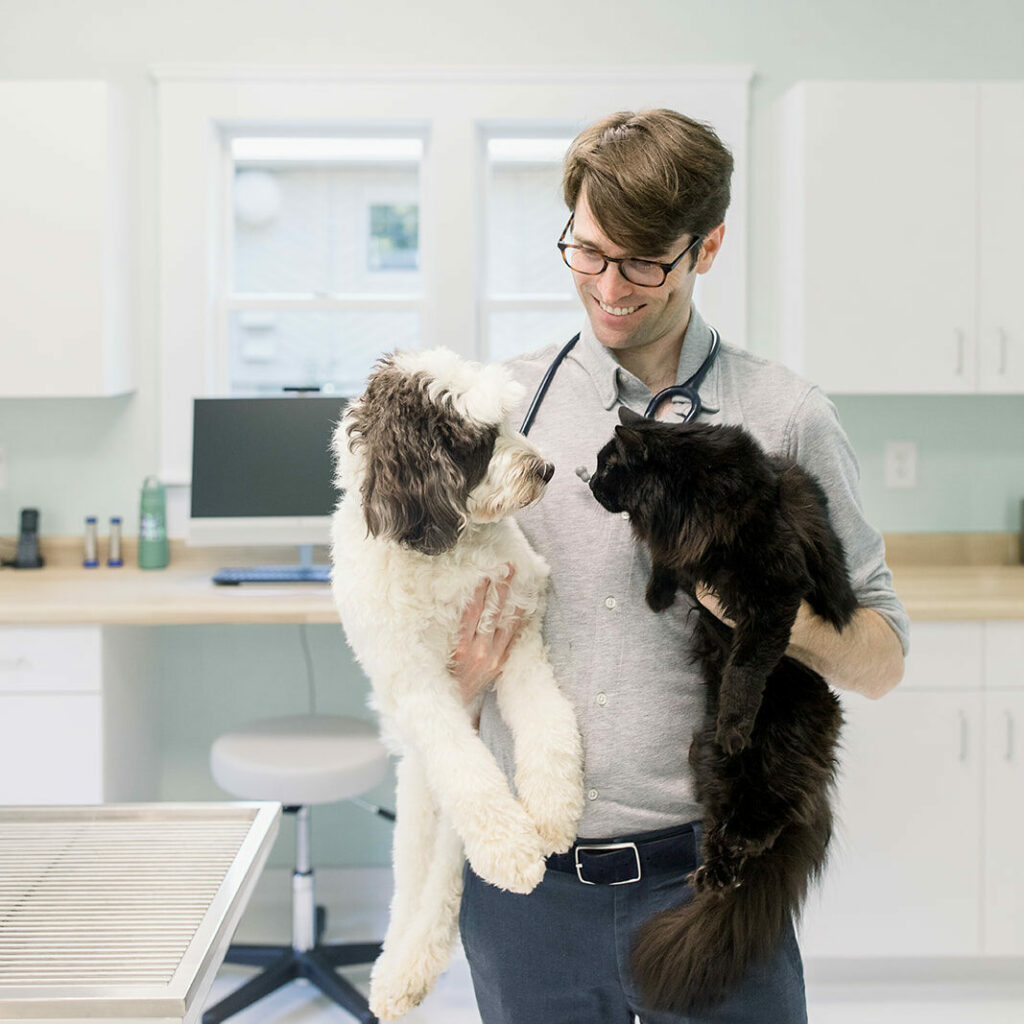
“Dr. Chris Simmons with clinic mascot Griffin at Simmons Veterinary Clinic, Decatur, GA.”
Starting From Zero, With Eyes Open
Before opening Simmons Veterinary Clinic, Dr. Simmons spent years working with Impromed at two busy practices: a large emergency and boarding hospital his father founded and eventually sold to VCA, and a 24/7 general practice where Dr. Simmons rose to COO. He saw, up close, what a legacy server-based system does to a team over time.
Every staff member learned their own way around the software. Nobody agreed on a standard process. SOAP notes were open text boxes, no different from a plain word processor. And the weight of ongoing client communication sat entirely with Dr. Simmons, with no practical way to keep it connected to the patient record or shared with the rest of the team.
When he decided to open his own de novo veterinary practice, he had one opportunity to get the foundation right. The question was not simply which practice management software to choose, but how to build a clinic where the technology would serve the team, rather than become one more thing people would have to learn to work around?

Building the Checklist Before You Look at Demos
Dr. Simmons did not start with vendor demos. He started with a Google Doc. In 2022, before speaking to a single sales team, he wrote down exactly what he needed from a veterinary PIMS. That list became his filter.
“To view these as things to be leveraged rather than things that will solve a problem; that’s the most important thing. If you didn’t clarify your pain points first, you’re not going to get what you need from the switch.” — Dr. Chris Simmons, MBA, Owner & Founder, Simmons Veterinary Clinic
His requirements:
- Cloud-based access with no local server to manage
- A clean, modern user interface
- Traceable, accessible client communications
- Strong automations for reminders and follow-up
- Third-party integrations for labs, payments, and telehealth
- Sensible inventory management
- Wellness plan support
- Mobile and tablet compatibility
Digitail met enough of those requirements to be the clear choice for a de novo launch. But the implementation strategy was just as important as the selection.
Dr. Simmons made two decisions that most clinics skip. First, he told his team to break the software. “I want to know how many times you can break this thing for me so I know how to fix it when we’re actually busy,” he told staff during training. That approach built genuine fluency before a full patient load arrived. It also shifted the team’s mindset from compliance to ownership.
Second, he intentionally reduced the appointment schedule during the first weeks of operation. He did not expect his team to perform at full efficiency while learning an entirely new system. That deliberate slowdown, counterintuitive as it feels, accelerated the long-term learning curve. The team got real repetitions without the pressure of a packed calendar.
The features that clicked fastest: the SOAP workflow, which brought diagnosis codes, discharge notes, invoicing, medication labels, follow-up scheduling, and task-setting onto one screen rather than across separate modules; the Flowboard, which became Dr. Simmons’ personal command center for tracking patient flow through the day; and the in-app chat, which gave the team a shared, asynchronous channel for client triage questions.
Three Years In, Still Choosing Depth Over Scale
Since day one, Simmons Veterinary Clinic has completed 1900 or more dog visits and 1000 or more cat visits, all from a standing start with no inherited client base, no corporate marketing budget, and efficient appointment slots.
1 in 4 appointments are booked directly through the Digitail pet parent app, reducing phone volume and front desk friction
1900+ dog visits and 1000+ cat visits were completed in year one at Dr. Simmons’ clinic, built entirely from a standing start with no inherited client base.
The feature Dr. Simmons returns to most consistently is Tails AI transcription. He runs long appointments by choice. He builds in time to talk through a patient’s history, learn what the owner is worried about, and make a real clinical connection. Without transcription, that depth of conversation came at a cost: thorough notes required significant time after the patient left, often reconstructed from memory.
Now, the conversation becomes the documentation. A 20-minute consult is captured in the background, flows into the correct SOAP fields, and is available for review later that evening if needed. “I am able to spend more time in there with them and be able to deliver more thorough notes,” Dr. Simmons explains. The result is not just efficiency. It is clinical confidence.
Pet parent app adoption at 62% tells a parallel story about intentional rollout. It did not happen organically. Dr. Simmons built a consistent system across every touchpoint: a download link on the website homepage, app mentions during appointment confirmations, a QR code in every exam room at checkout, and team-wide reinforcement at check-in and check-out. Clients book their own appointments, access their pet’s records without calling, and send triage questions through in-app chat rather than leaving voicemails. Front-desk load drops. Communication stays in one place.
“I can have a 20-minute conversation and know that it can go into all the right places in the SOAP later. That allows me to be more human in the room.”
— Dr. Chris Simmons, MBA, Owner & Founder, Simmons Veterinary Clinic
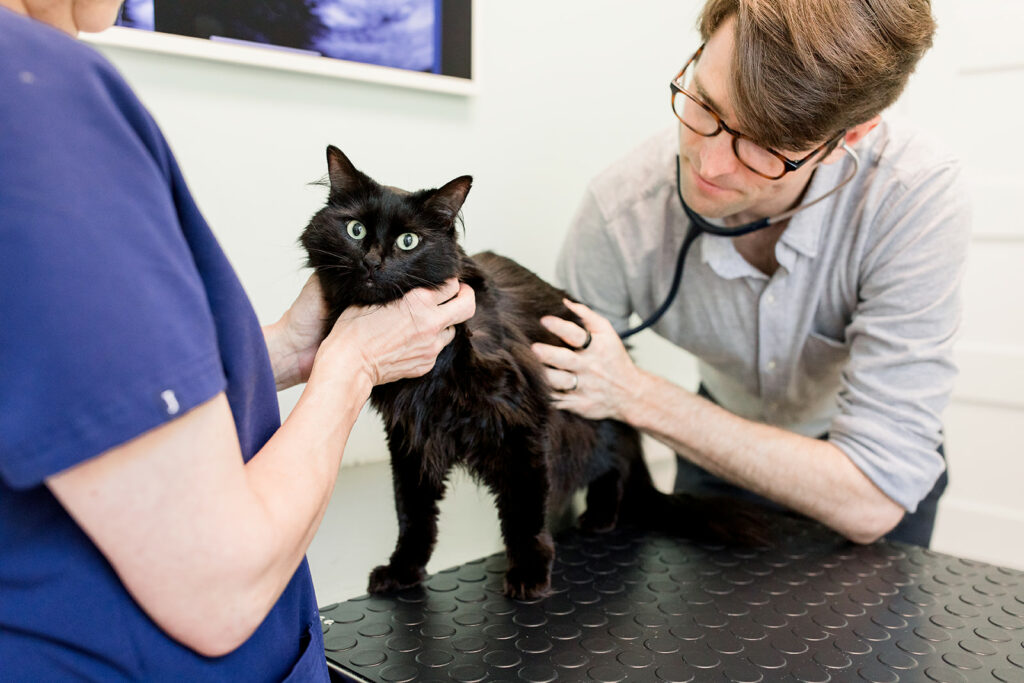
“Longer appointment windows with every patient are a deliberate choice at Simmons Vet, and Tails AI transcription makes every minute count.”
KEY TAKEAWAYS
- Build your PIMS checklist before you talk to vendors.
Dr. Simmons wrote down his requirements in 2022 before a single demo. Clinics that skip this step evaluate features instead of solutions. Know your pain points first. Then find out which platform actually addresses them. - Slow down to speed up.
Reducing the appointment schedule during the first weeks of implementation is counterintuitive. It is also one of the highest-leverage decisions a clinic can make during a PIMS transition. The team needs real repetitions with the system before the pressure of a full calendar arrives. Protect that window. It pays back quickly. - App adoption is a system, not a hope.
Simmons Vet’s 62% adoption rate came from consistent, multi-touchpoint promotion: the website, pre-appointment reminders, in-room QR codes, and team-wide reinforcement. If you want clients to use the technology, you have to build the ask into every step of the visit.
WATCH OUTS & LESSONS LEARNED
- The de novo path requires financial runway. Dr. Simmons had the cushion to absorb losses for two and a half years while building toward profitability. Not every practice owner will have that flexibility. If you are starting from scratch, build a financial model that accounts for the time between launch and break-even before you commit to the overhead of an independent practice.
- Inventory management takes iteration. Dr. Simmons worked through friction with Digitail’s inventory tools early on, some of it his own learning curve, some of it platform limitations that have since been addressed. Plan time to configure and test inventory workflows before going live, and expect to refine them as volume grows.
- Software is a tool, not a solution. This is the throughline of everything Dr. Simmons describes. The clinics that get the most from a new PIMS are the ones that approach implementation with clear intent. Know what you are trying to fix. Leverage the platform deliberately. Then build the habits and team behaviors that make the technology useful.
Dr. Simmons is candid that the de novo path is not for everyone. He had the financial cushion to absorb two and a half years of losses while building toward profitability, and he is the first to say that not every veterinarian opening a practice will have that runway. His advice: if you are starting fresh, go in with clear financial modeling, and do not mistake software capability for business sustainability. He also notes that inventory management in Digitail took time and iteration to get right, some of it his own learning curve and some of it platform gaps that have since been addressed. His broader point: the clinics that get the most from a new PIMS are the ones that treat it as a tool to leverage, not a solution that runs itself.
