

Sound comes before behavior. Is your practice listening?

When a dog lunges at the door of an exam room, or a cat becomes rigid at the first touch of a stethoscope, the default response is behavioral. Difficult patient. Anxious owner. High-stress breed.
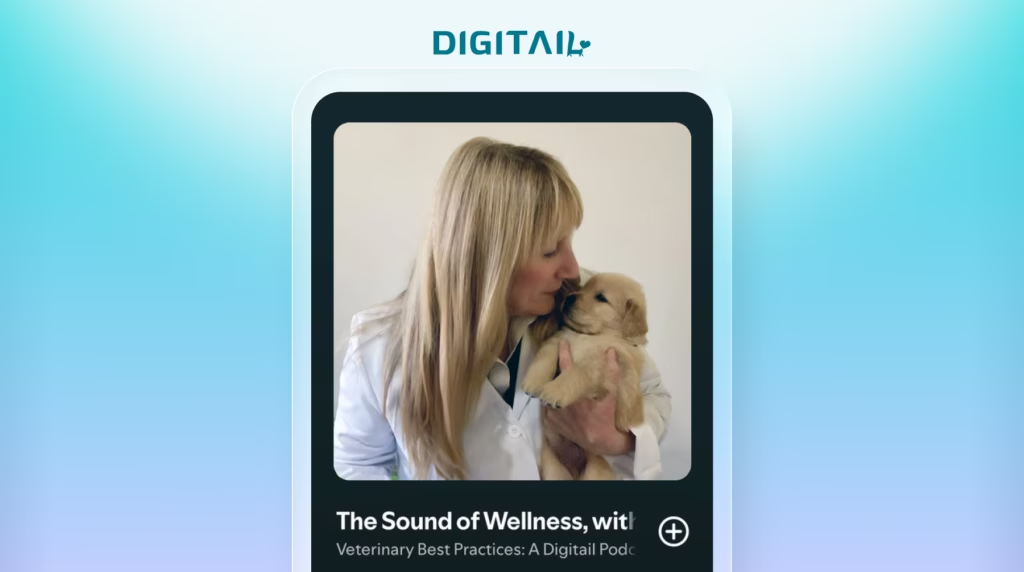
Janet Marlow, founder of Pet Acoustics and a classically trained guitarist who once performed at Carnegie Hall, has spent nearly 30 years asking a different question: what if the behavior is downstream of something auditory?
After noticing the profound physical relaxation her own dogs and cats showed during her practice sessions, Marlow left a performance career to research animal hearing. She’d developed the world’s first species-specific animal music by 1997 and founded Pet Acoustics twelve years later. And across more than 50,000 hearing screenings conducted in 76 countries, her team has found that 1 in 2 pets has some degree of hearing loss. On Veterinary Best Practices, Marlow joined host Dana Panduro to explain what that number means for every clinic still relying on a clap behind the ear.
Hearing health is no longer a specialty referral. It is a core component of a complete wellness exam.
Why veterinary medicine has a hearing gap
When Marlow began her research in the late 1990s, she pulled veterinary textbooks to see how much had been written about hearing — not ear anatomy, but the functional role of sound in animal health and wellbeing. She found a page and a half.
The tools available to veterinarians today haven’t advanced much. There’s the hand-clap or clipboard-drop behind the ear, which Marlow notes “causes a startle reaction, so it’s not fear-free, and it doesn’t give a veterinarian any sense of the gradation of what an animal actually hears.” And there’s the Brainstem Auditory Evoked Response (BAER) test, which has been the gold standard since 1971, requires sedation in many cases, attaches electrodes to the animal, and demands a specialist referral and significant cost.
Between those two options sits a wide open gap: a routine, accessible, fear-free tool that a veterinarian, vet tech, or pet parent can use in two minutes, during any exam, with no specialized equipment. Pet Acoustics started in this gap.
Species-specific music: not background ambience
Most clinics playing music in their waiting rooms are playing it for the humans. Classical music is a common choice, the assumption being that if it sounds soothing to us, it probably helps animals too.
Marlow, as a fifth-generation classical musician, is clear: “Mozart didn’t write for dogs.”
The Pet Acoustics soundscapes are composed differently, composed at the frequency level. Marlow identifies the specific ranges that trigger calm responses in dogs, cats, horses, and birds, and removes the ones that provoke hypervigilance. Volume levels are engineered to stay within the 50 to 80 decibel range that dogs and cats tolerate most comfortably. There is no percussion, no voice, no sudden dynamic shifts.
The results have been validated biometrically. In a study at the University of Lublin in Poland, 120 Arabian horses were divided across two groups: 90 exposed to Pet Acoustics equine music, 90 without. Cortisol blood work showed measurably lower stress levels in the music group — and the horses exposed to the music went on to win more races. A separate study, prompted by a direct call from Dr. Temple Grandin, compared Pet Acoustics music against classical music and silence across dog subjects, measuring pulse rate, heart rate variability (HRV), and activity level. Pet Acoustics music produced the strongest calming biometric profile of the three.
“That’s called wellness,” Marlow said. “It’s the continued health effect even when the music isn’t actively playing.”

What 50,000 screenings actually showed
The Pet Acoustics Plus app has been downloaded by pet parents, vet techs, veterinarians, shelter workers, and kennel staff across 76 countries. Marlow’s team pulled data from 10,000 of those screenings to look for patterns. The main pattern — and the most concerning — was that 1 in 2 pets tested showed some partial hearing loss.
The loss is often gradual and frequency-specific. A senior dog might still have intact low-frequency hearing while losing the high-frequency range entirely, meaning the owner’s voice, which lands in the mid-to-high range, goes unanswered. Owners call it “selective hearing.” The veterinarian calls it normal aging. Without frequency-specific data, neither has the tools to know what’s actually happening.
Marlow also found that repeat testing was common. Pet parents weren’t testing once and moving on. They returned every six months, building a longitudinal hearing profile across the animal’s life. Panduro drew the direct parallel during the episode: “It’s the same logic as pre-anesthetic bloodwork. You want to know what’s normal for that individual animal so that deviation actually means something.”
Sound comes before behavior
When an animal is stressed, agitated, or reactive in the exam room, the reflexive read is behavioral. But as Marlow puts it: “Sound comes before behavior.” A dog reacting to its environment may be responding to a frequency the veterinary team cannot hear. A cat that tenses before the exam even begins may be picking up ambient high-frequency noise from refrigerators, computers, or HVAC systems. The behavior is real, but the cause may not be what it looks like.
The Pet Acoustics hearing screen gives a veterinarian something they don’t currently have: a starting point for a different conversation with the pet parent. Instead of “your pet has anxiety, here’s a medication option,” the conversation becomes “your pet’s mid-frequency hearing is declining, here’s what that likely means for their responses, and here’s what we can do.”
Panduro raised a parallel that hits differently if you’ve run a full appointment schedule. A pre-COVID study of veterinary professionals asked why they believed clients skipped wellness exams. The near-universal answer was cost. When the same question was put to pet owners directly, the most common answer was stress to the pet. Sound management — from the carrier at home to the exam room itself — addresses that barrier in a way no pricing change ever will.
A two-minute test that belongs in every exam
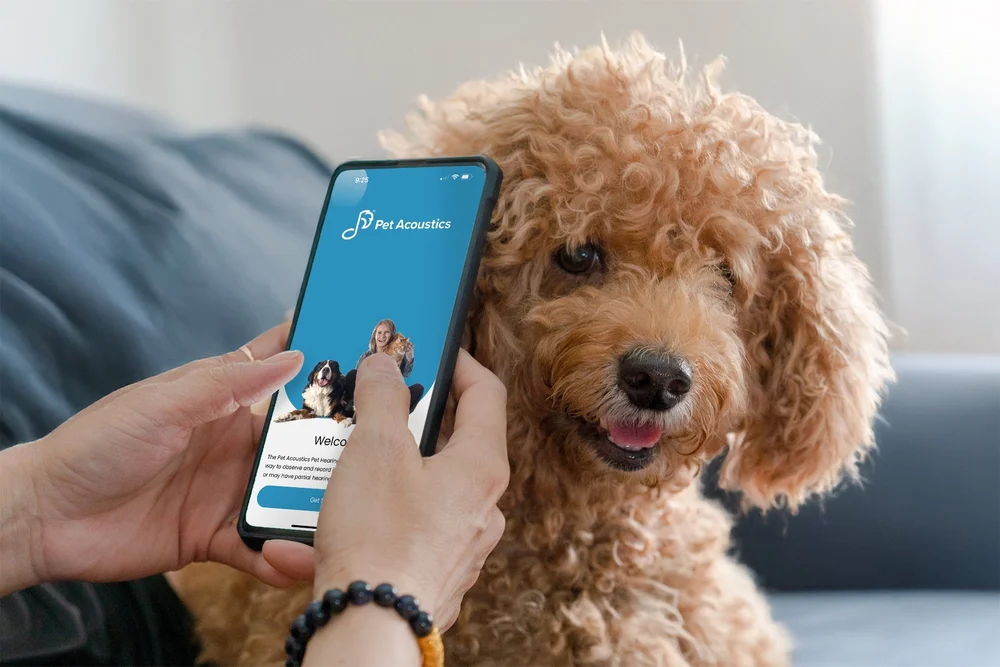
The Pet Acoustics Plus app delivers a hearing screen in under two minutes. The pet sits near a speaker. A series of sounds moves through high, mid, and low frequency ranges. The owner or vet tech notes the animal’s ear and body responses in the app. A PDF report generates automatically, ready to share with the client and add to the patient record. It doesn’t require sedation, a specialist, or even equipment beyond a phone or tablet. The screen is billable. It differentiates the clinic as a leader in preventive care. It establishes a hearing baseline trackable across the animal’s lifetime. And it creates client education conversations that build client relationships that a vaccination reminder can’t.
“In time,” Marlow said, “this will become part of standard care — alongside dental, cardiac, and ear exams. The tool gap is closing.”
FAQ
The Pet Acoustics Plus app plays a series of sounds across three frequency ranges: high, mid, and low. The owner or vet tech observes the animal’s ear and body responses and logs them in the app. A PDF report is generated automatically. The process takes under two minutes and requires no equipment beyond a phone or tablet.
Yes. Pet Acoustics soundscapes are composed around the specific hearing ranges of dogs, cats, horses, and birds. Volume levels are kept between 50 and 80 decibels. Frequencies that trigger hypervigilance are removed. The approach has been validated in biometric studies measuring cortisol, HRV, and pulse rate. Classical music is written for human hearing and has not shown the same calming effect in animal studies.
Yes. The app is designed for pet parents as well as veterinary teams. Many pet owners use it as a baseline screening between annual exams, building a longitudinal record that makes changes easier to identify over time.
Marlow and many veterinarians now recommend playing Pet Acoustics sound therapy in the carrier before and during transit, in the waiting room, and for 30 minutes after a visit to support cortisol recovery. Biometric studies show it measurably lowers cortisol and raises HRV, the physiological markers of reduced stress.
Yes. The hearing screen can be integrated into a wellness exam as a billable service, with a professional PDF report shareable with clients and addable to patient records.
Listen to the full episode
The full conversation on Veterinary Best Practices covers how Marlow built the science behind species-specific music across three decades, the story of a seven-year-old dog that went undiagnosed as deaf for nearly a year after his companion passed, and how longitudinal hearing tracking could eventually become as routine as annual bloodwork. Dana and Janet also walk through the practical steps for auditing your clinic’s sound environment today.
Support Better Patient Experiences
If your team is ready to build a practice where preventive care goes deeper than the standard checklist, book a Digitail demo and see how Digitail fits the rhythm of a real day.