

Integrated Payments: Why Modern Veterinary Merchant Services Matter for Revenue


Veterinary practices are bringing in more revenue, but they’re not necessarily seeing more patients.
According to the Veterinary Hospital Managers Association’s October 2026 report, revenue among participating practices increased 2.7% year over year in September, while patient visits declined 1.1%. Revenue per patient rose 4.3%.
For practice owners and managers, these numbers reinforce the importance of protecting margins, managing operating costs, and making the most of existing client relationships.
Payment processing is one area worth revisiting.
Most veterinary practices already have established billing procedures and merchant services in place. But as payment technology evolves, it’s worth considering whether those systems are still the most efficient and cost-effective option.
Modern integrated payments now do much more than connect a card terminal to practice management software. They can support financing, automated billing, remote payments, and financial reporting—all of which can influence a practice’s financial performance.
The True Cost of Veterinary Merchant Services
When comparing payment providers, practices often focus on transaction rates. And for good reason: even relatively small differences can add up.
For a practice processing $1.5 million in electronic payments annually, a difference of 0.3 percentage points in the effective processing rate represents $4,500 in annual costs.
But processing fees don’t tell the whole story.
The total cost of accepting payments also includes hardware, software, administrative work, and the time spent managing transactions and reconciling financial records.
For example, a practice using a standalone payment processor may need to reconcile transactions between its merchant platform and veterinary software. Even with well-established procedures, that creates additional administrative work.
Integrated systems reduce some of this workload by automatically recording transactions against invoices and keeping payment information within the practice management platform.
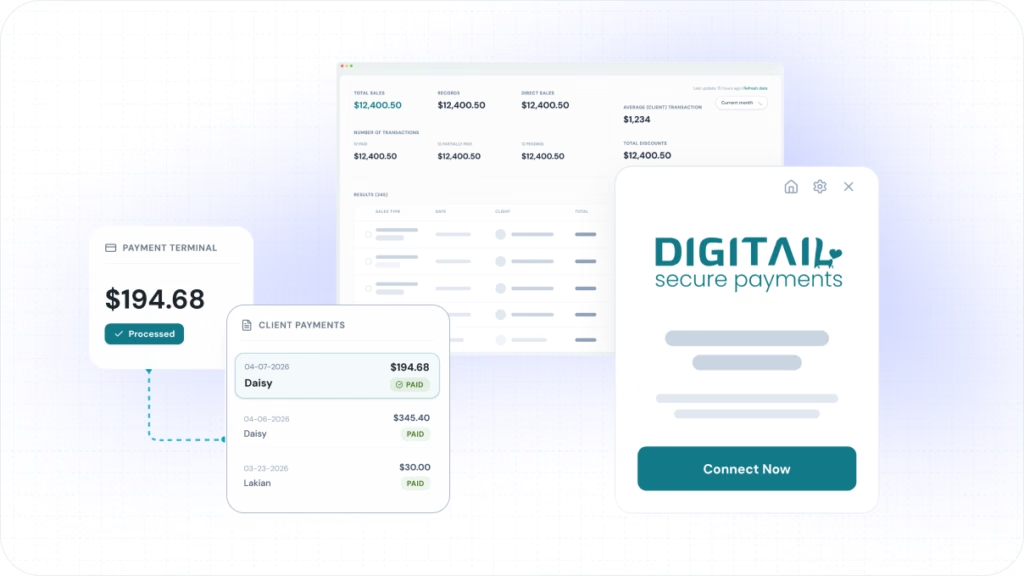
With Digitail Secure Payments, for example, successful transactions are recorded against their corresponding invoices, and end-of-day payment reports are available within the PIMS.
This doesn’t eliminate the need for financial reconciliation, but it can make the process considerably more efficient.
Understanding Veterinary Payment Processing Fees
Pricing structures also deserve attention.
Some merchant service providers use flat-rate pricing, while others offer interchange-plus or customized arrangements based on transaction volume.
Each model has advantages, depending on the practice’s payment volume, average transaction size, and mix of card-present and online payments.
A practice processing a high volume of transactions may benefit from negotiating a customized rate. Another may prefer predictable pricing and fewer administrative complexities.
It’s also important to understand whether online transactions, financing, hardware, or additional services carry separate fees.
The key takeaway is that the lowest processing rate doesn’t necessarily mean the lowest overall payment costs.
Practices should evaluate what they’re paying for and whether the technology provides enough operational value to justify the expense.
How Flexible Payment Options Support Veterinary Practice Revenue
Affordability remains one of the biggest challenges in veterinary medicine.
The 2026 PetSmart Charities–Gallup State of Pet Care Study found that 94% of surveyed U.S. veterinarians said client financial considerations sometimes or often limit recommended care.
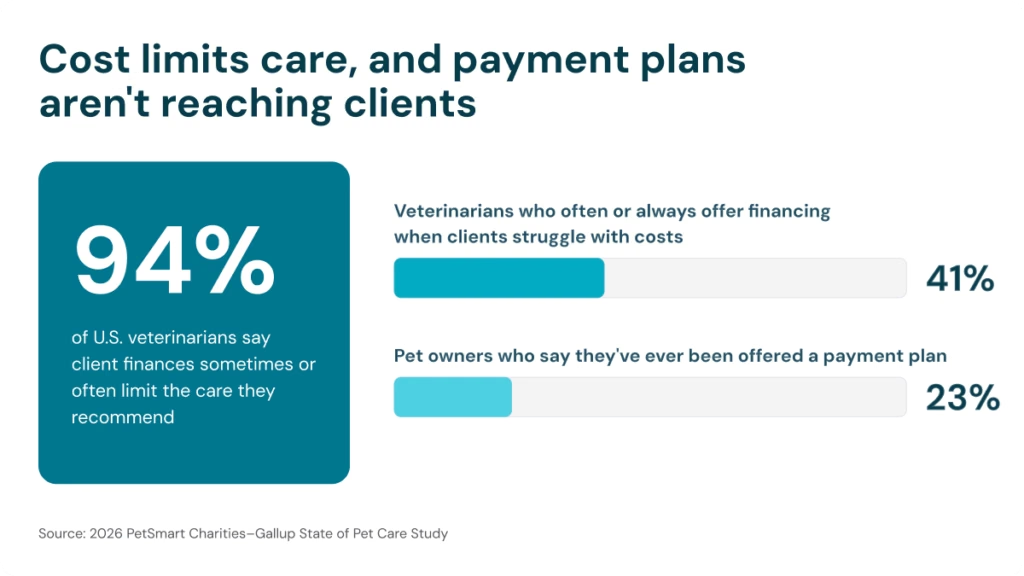
The study also identified a gap in how frequently financing is offered. While 41% of veterinarians reported often or always providing financing options when clients struggle with costs, only 23% of surveyed pet owners said they’d ever been offered a payment plan.
For veterinary practices, financing itself isn’t new. Many already work with third-party providers to help clients manage larger expenses.
What’s changing is how easily those options can be incorporated into existing payment workflows.
Making Financing Part of the Payment Experience
Some integrated payment platforms now offer buy now, pay later options directly at checkout.
Instead of directing clients to a separate financing application, practices can offer eligible clients the option to divide payments into installments through supported providers.
For example, Digitail Secure Payments supports buy now, pay later options for eligible clinics in the United States and Canada. Clients can choose an available installment plan, while the practice receives payment upfront from the provider, subject to applicable fees and terms.
This can make financing more convenient for both clients and veterinary teams.
However, it’s important to consider the economics. Financing transactions may carry different fees from standard card payments, and approval rates and repayment terms vary by provider.
The goal isn’t simply to offer more payment methods. It’s to make appropriate options accessible without adding unnecessary complexity or costs.
Beyond Checkout: Deposits, Remote Payments, and Recurring Revenue
Integrated payment systems can also help practices manage collections outside the traditional checkout process.
For hospitals with established deposit policies, collecting payment during online booking can reduce the administrative work involved in securing appointments.
Cards on file offer another option, allowing practices to securely store payment methods with client authorization for future transactions.
Payment links can also make collections easier, particularly for medication pickups, outstanding balances, and mobile veterinary services.
Instead of requiring every transaction to happen at the front desk, clients can complete payments remotely while the transaction remains connected to their account.
These capabilities are increasingly common in modern payment systems, but another area is particularly interesting from a revenue management perspective: recurring billing.
Automating Veterinary Wellness Plan Payments
Wellness plans and preventive care memberships can help practices build stronger client relationships while generating more predictable revenue.
However, recurring payments introduce additional work, including managing subscriptions, monitoring failed transactions, and keeping billing records accurate.
Integrated payment solutions simplify these processes by automating scheduled collections and maintaining payment histories within the PIMS.
Digitail Wellness Plans takes this a step further by connecting the entire wellness plan experience within the practice management system. Practices can create customized plans, automate recurring payments, and track benefit usage as services are provided.
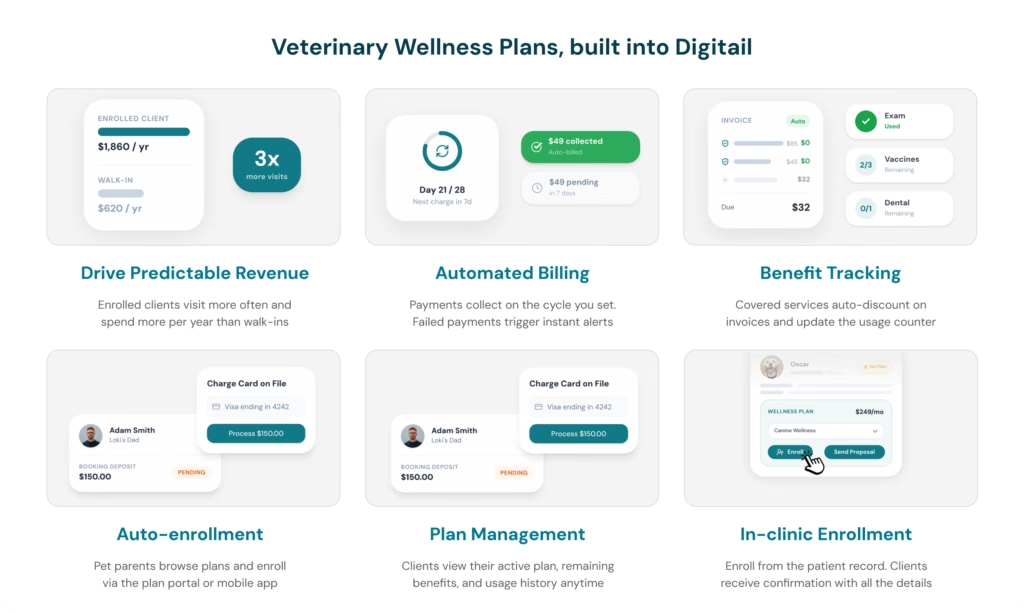
Pet owners can also enroll online or through the client app, while failed payments trigger notifications and can be resolved directly through the pet portal. This reduces the administrative work associated with managing memberships and recurring collections.
Of course, automated billing doesn’t determine whether a wellness plan is profitable. Pricing, enrollment, utilization, and retention remain essential.
But having the right infrastructure makes these programs easier to operate and scale.
How Integrated Payments Improve Financial Reporting and Reconciliation
One of the most familiar benefits of integrated payments is faster checkout. But for practice managers, the value often extends beyond the transaction itself.
When payments, invoices, and financial reports are connected, it’s easier to understand payment activity without switching between multiple systems.
Automated transaction recording and reconciliation can reduce repetitive work, while centralized reporting provides a clearer view of collections.
For multi-location veterinary groups, having consistent payment data across hospitals can also make financial comparisons easier.
Beyond total revenue and average transaction values, several payment-related metrics are worth monitoring:
| Metric | What It Helps Evaluate |
| Effective processing rate | Actual merchant fees relative to processed payment volume |
| Payment method mix | Distribution of transactions across payment types, including online payments and financing |
| Outstanding balances | Unpaid invoices and collection performance |
| Reconciliation time | Administrative resources spent matching payment records |
| Recurring payment performance | Successful collections, failed payments, and subscription billing reliability |
These metrics help practices evaluate payment processing as an operating expense rather than simply a transaction service.
For example, an increase in online payments may affect the overall processing rate, while a growing wellness plan program may change the practice’s recurring payment volume.
Understanding these changes can help managers evaluate whether their current merchant services arrangement still makes financial sense.
How to Choose Veterinary Merchant Services for Your Practice
The focus should be on finding a solution that supports your existing operations and financial priorities.
For some practices, processing costs will be the deciding factor. For others, better integration, automated collections, or recurring payment capabilities may deliver greater value.
When evaluating veterinary merchant services, several factors deserve attention:
- Total payment costs: Consider effective processing rates, transaction fees, hardware, and any additional software expenses.
- PIMS integration: Look for automatic transaction recording, connected invoices, and streamlined reconciliation.
- Payment flexibility: Evaluate support for online payments, deposits, cards on file, and financing options.
- Recurring billing: Consider subscription management and automated collections if the practice offers wellness plans.
- Financial reporting: Make sure transaction histories, outstanding balances, and payment reports are easily accessible.
The right combination will depend on the practice’s size, services, and operational model.
For a broader comparison, explore our guide to the best veterinary payment processing and POS systems.
Making Integrated Payments Part of Your Financial Strategy
Merchant services may not be the largest operating expense, but payment-related costs and processes affect nearly every client transaction.
Integrated payments can help reduce administrative work, support recurring billing, and provide more flexibility in how clients pay for veterinary care.
Solutions like Digitail Secure Payments bring these capabilities into the PIMS, connecting payment collection with existing billing and financial workflows.
For practice owners and managers, the opportunity is to look beyond processing rates and evaluate how well their payment technology supports the business as a whole.
The goal isn’t just to process transactions efficiently. It’s to make sure the cost, flexibility, and management of payments contribute to the practice’s long-term financial health.
Simplify Payments, Strengthen Your Practice’s Financial Health
From integrated payment processing to automated billing and flexible payment options, see how Digitail helps your practice manage payments more efficiently.