

How to Value a Veterinary Practice: Methods, Formulas, and How to Prepare


Disclaimer: This article is for informational purposes only and does not constitute professional valuation, financial, legal, or tax advice. The example figures and valuation multiples are illustrative, not industry benchmarks. Actual practice values depend on individual financial performance, market conditions, and transaction-specific factors.
What is your veterinary practice actually worth?
Many owners ask that question when they consider retirement, bring in a partner, or prepare to sell their hospital. The answer is just as useful when no sale is planned.
A practice valuation tells you more than what a buyer might pay. It shows how effectively your business generates profit, where operational risks exist, and which improvements could make your practice more valuable over time.
This guide connects the two halves of that picture: the valuation methods that calculate value, and the key performance indicators (KPIs) that drive it.
What Determines the Value of a Veterinary Practice?
Two veterinary hospitals can generate the same annual revenue and still have very different valuations. Take two practices that each bring in $2 million a year.
| Practice A | Practice B | |
|---|---|---|
| Annual revenue | $2 million | $2 million |
| Profit | Stable | Reduced by significantly higher operating costs |
| Team | Well-established veterinary team | Frequent staff turnover |
| Owner’s role | Work is shared across the team | Clinical work depends heavily on the owner |
| Client demand | Consistent | Less predictable |
Their revenues are identical, yet Practice A may be worth considerably more. A practice’s value depends on five connected factors:
- Profitability: how much income the business generates after covering its operating expenses.
- Growth: whether revenue and earnings increase consistently.
- Operational efficiency: how effectively the practice manages staff, inventory, facilities, and other resources.
- Business risk: how dependent the practice is on its owner, individual veterinarians, or a limited client base.
- Future earnings potential: whether the business can sustain and grow its financial performance.
Professional valuation standards turn these factors into numbers through three main approaches: the income approach, the market approach, and the asset approach. Each approach measures value differently and relies on particular financial information.
How to Calculate the Value of a Veterinary Practice: Valuation Methods Compared
Appraisers work with three approaches and several calculation methods inside them.
| Method | Primary metric | Formula | Best used for | Main limitation |
|---|---|---|---|---|
| Adjusted EBITDA multiple | Normalized operating earnings, after a market-rate salary for the owner’s work | Adjusted EBITDA × multiple | Multi-doctor practices and sales to corporate or investor buyers | Requires careful, documented adjustments; the multiple needs market support |
| Discounted cash flow (DCF) | Forecast free cash flow over several years | Present value of forecast cash flows + present value of terminal value | Practices whose earnings are expected to change, such as an expansion | Sensitive to growth and discount-rate assumptions |
| Capitalization of earnings | One year of sustainable earnings or cash flow | Sustainable earnings ÷ capitalization rate | Established practices with stable earnings | Does not handle uneven growth |
| Comparable sales | Prices paid for similar practices | Comparable EV/EBITDA or EV/revenue × your figure | Cross-checking against real transactions | Private sale data is often undisclosed |
| Revenue multiple | Annual revenue | Revenue × revenue multiple | A quick reference when earnings data is unavailable | Ignores operating costs and profit |
| Seller’s discretionary earnings (SDE) multiple | Earnings plus one working owner’s compensation | SDE × SDE multiple | Smaller, owner-operated practices | Not interchangeable with EBITDA multiples |
| Adjusted net assets | Fair market value of assets and liabilities | Assets − liabilities | Practices with limited profit, large equipment or property holdings, or liquidation | Leaves out most goodwill in a profitable practice |
These methods are alternatives for estimating value. Their results are not added together. A professional valuator may use more than one to cross-check the result.
1. What Is Adjusted EBITDA and Why Does It Matter?
EBITDA stands for Earnings Before Interest, Taxes, Depreciation, and Amortization. It measures operating earnings before those specific expenses.
Financial statements don’t always reflect the earnings a new owner could reasonably expect. An owner might receive compensation well above the market rate for their clinical and management work. The business might also have paid a one-time legal expense.
Adjusted EBITDA accounts for legitimate differences between reported earnings and sustainable operating earnings:
Adjusted EBITDA = Reported EBITDA + Supported Adjustments − Required Normalizing Expenses
Three rules apply:
- Adjustments may include documented nonrecurring expenses or compensation differences.
- They must also include the realistic cost of replacing the owner’s work. For reference, the US Bureau of Labor Statistics reports a median annual wage of $130,100 for veterinarians as of May 2025.
- Depreciation and amortization are already excluded from EBITDA, so they are not added back a second time.
This distinction matters for veterinary practices. A profitable owner-operated hospital may be less profitable after it pays another veterinarian and a manager to perform the owner’s responsibilities.
How the EBITDA Multiple Method Works
The EBITDA multiple method estimates a practice’s value by applying a valuation multiple to its normalized operating earnings. The multiple may be derived from comparable business transactions, making this a form of market-based valuation. The method is commonly used when evaluating established veterinary practices, particularly in acquisition discussions. It is especially relevant to established veterinary hospitals with a history of consistent earnings.
The simplified formula is:
Practice Enterprise Value = Adjusted EBITDA × Valuation Multiple
| Financial metric | Annual amount |
|---|---|
| Revenue | $2,000,000 |
| Adjusted EBITDA | $300,000 |
| EBITDA margin | 15% |
| Illustrative valuation multiple | 6× |
| Estimated enterprise value | $1,800,000 |
In this example, the practice’s estimated enterprise value is $1.8 million. The 6× multiple is a hypothetical assumption. It is not a veterinary industry benchmark.
Actual multiples depend on practice size, location, growth, profitability, staffing stability, and buyer demand. A clinic with predictable earnings and limited owner dependence may command a higher multiple than a similar clinic with greater operational risks.
2. Discounted Cash Flow (DCF) Method
The DCF method estimates the future cash flow a practice can generate and converts those amounts into today’s value.
Practice Value = Present Value of Forecast Cash Flows + Present Value of Terminal Value
A DCF valuation typically involves four steps:
- Forecast revenue, expenses, and operating performance over several years.
- Estimate future free cash flow after taxes, capital expenditures, and working-capital needs.
- Apply a discount rate that reflects the risk of receiving those future cash flows.
- Estimate the value of the business beyond the forecast period (the terminal value).
Take a practice that is expanding into a larger facility and expects earnings to rise over the next five years. A DCF model can account for that growth, but it must also include the cost of new equipment, additional staff, and other investments.
Unlike EBITDA, free cash flow reflects the money available to capital providers after these operating and investment requirements.
3. Capitalization of Earnings
This method converts one sustainable annual earnings or cash-flow figure into value using a capitalization rate.
Value = Sustainable Annual Earnings or Cash Flow ÷ Capitalization Rate
For example, $200,000 in sustainable annual cash flow divided by an illustrative 20% capitalization rate produces a value of $1 million.
The method works best when earnings are relatively stable. The capitalization rate must reflect the cash flow being valued, expected growth, and business risk. A multiple is the same idea in reverse: a 20% capitalization rate equals a multiple of 5.
4. Valuation Based on Comparable Veterinary Practice Sales
The market approach compares a veterinary practice with similar businesses that have been sold. It answers one question: what have buyers paid for comparable veterinary hospitals?
Two common comparison measures are:
EV/EBITDA = Enterprise Value ÷ Adjusted EBITDA
EV/Revenue = Enterprise Value ÷ Annual Revenue
If comparable practices sold at an average of 5× adjusted EBITDA, a hospital generating $250,000 in adjusted EBITDA would have an indicative enterprise value of $1.25 million, before adjustments for differences between the practices.
Revenue multiples offer a reference when earnings information is unavailable. Revenue alone doesn’t account for differences in operating costs, so it is a weaker measure of value.
Keep three limits in mind:
- Comparability. Valuators consider practice size, specialty, geographic market, profitability, growth, staffing, and transaction terms. A multi-location emergency hospital is not comparable to a single-doctor general practice, even if their revenues are similar.
- Data availability. Private veterinary practice transactions are not always publicly disclosed. Without reliable transaction data, a market-based estimate can mislead.
- Timing and deal type. VetPartners has described how veterinary acquisition multiples have changed over time, particularly in corporate transactions. Transaction date, buyer type, and deal structure all matter when you read a market valuation.
5. Valuation Based on What the Practice Owns
The asset approach estimates value from the practice’s assets and liabilities.
Adjusted Net Asset Value = Fair Market Value of Assets − Liabilities
Assets may include:
- Medical equipment and diagnostic technology
- Furniture and fixtures
- Pharmaceutical and medical inventory
- Cash and collectible accounts receivable
- Other identifiable tangible and intangible assets
Liabilities may include:
- Loans
- Outstanding payables
- Other financial obligations
A practice with $800,000 in assets at fair market value and $300,000 in liabilities would have an adjusted net asset value of $500,000.
An established veterinary practice may be worth substantially more than its physical assets because of its reputation, trained team, client relationships, and ability to generate future earnings. Part of that additional value is called goodwill.
The asset approach is most useful for practices with limited profitability, significant equipment or property holdings, or businesses being evaluated for liquidation. It also serves as a cross-check against income-based valuations.
6. Seller’s Discretionary Earnings (SDE): Valuing Small, Owner-Operated Practices
For smaller, owner-operated practices, another useful earnings measure is seller’s discretionary earnings. SDE estimates the economic benefit available to one full-time owner-operator before certain discretionary and financing expenses.
SDE = Pretax Earnings + Interest + Depreciation + Amortization + One Owner’s Compensation + Supported Adjustments
The valuator then multiplies SDE by a market-supported SDE multiple.
Unlike adjusted EBITDA, SDE includes the compensation of one working owner. That makes it relevant to smaller practices where the owner is directly involved in daily clinical operations.
SDE multiples and EBITDA multiples are not interchangeable. A practice valued using SDE must be compared with transactions measured on the same basis.
Enterprise Value vs. Equity Value: What Does the Owner Actually Receive?
A valuation based on EBITDA typically estimates enterprise value. That figure is not the final amount the owner receives.
- To move from enterprise value to equity value, a valuator commonly adjusts for debt, cash, and other transaction-specific items.
- An asset valuation must state which assets and liabilities the transaction includes.
- Real estate is often valued separately if the practice sale does not include it.
How to Prepare for a Veterinary Practice Valuation
You don’t need to be planning a sale to start. Preparation is mostly a matter of getting clean numbers in place early enough for them to show a trend.
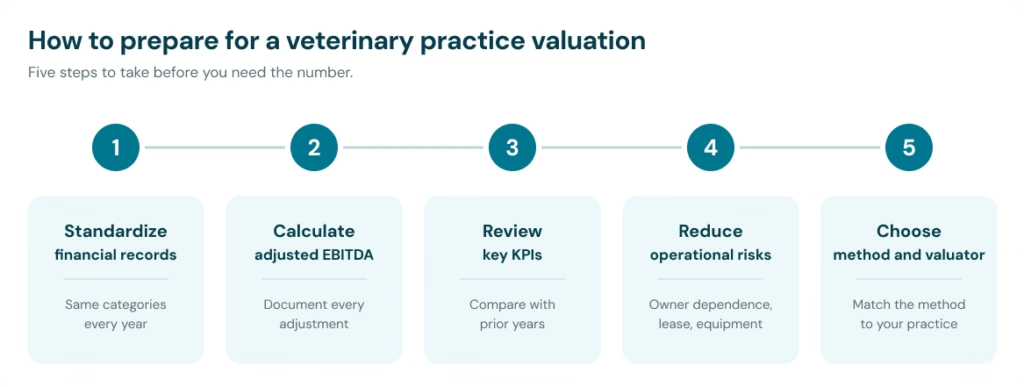
Step 1: Standardize Your Financial Records
Use the same accounting categories every year so trends can be compared. The VMG/AAHA Chart of Accounts, updated in 2026, gives veterinary practices a shared framework. It also lets you compare your expense ratios with published benchmarks, because your categories match the ones the benchmark studies use.
Step 2: Calculate Your Own Adjusted EBITDA
Work out reported EBITDA, then list every adjustment with a document that supports it. Veterinary appraiser Karen Felsted, CPA, DVM, CVA, lists the common ones: payments to owners, rent when the owner also owns the building, services provided by family members, and perks.
Set your own pay at the market rate for the clinical and management work you do. Each normalization adjustment should be supported by financial records and a clear explanation of why it reflects the practice’s sustainable earnings. The AICPA’s valuation standards provide a professional framework for valuation engagements, while proper documentation helps make the calculation more credible and defensible during buyer due diligence.
Step 3: Review the KPIs That Feed the Formulas
Start with revenue growth, profitability, cost of goods sold, labor expenses, revenue per FTE veterinarian, active clients, and client retention. Compare each one with your own previous years and with relevant industry data. AAHA’s guidance on financial data and benchmarks recommends tracking expenses as a percentage of gross revenue, particularly drugs and medical supplies, laboratory costs, doctor compensation, staff compensation, benefits, and facility costs.
Step 4: Identify and Reduce Operational Risks
Ask whether the practice can hold its performance if you leave, a veterinarian resigns, or a major expense increases.
- Measure the share of production you generate personally, and plan how to spread it across associates.
- Document procedures so the practice does not depend on what one person remembers.
- Check the remaining term and renewal provisions of your lease.
- Note equipment that will need replacement in the next few years.
Step 5: Choose the Right Valuation Method and a Qualified Valuator
Match the method to your practice, using the comparison table above. A stable multi-doctor hospital suits an EBITDA-based method. A small owner-operated clinic suits SDE. A practice in the middle of an expansion suits a DCF. Review the assumptions behind each estimate, and do not treat one calculation as a guaranteed sale price.
Veterinary Practice Value Is Built Before the Sale
A valuation is not only a calculation performed when an owner decides to sell. It reflects years of financial performance, operational decisions, client relationships, and business development.
Understanding the valuation methods gives you a starting point. Tracking the right KPIs shows you what can actually improve.
A practice with consistent profitability, reliable clinical capacity, stable client relationships, and manageable operational risks is better positioned to sustain its earnings and demonstrate its value. Demonstrating it takes records you can trust. Digitail keeps your financial, inventory, appointment, and client data in one practice management system, so the numbers a valuator asks for are ready when you need them.
Run Your Veterinary Practice Efficiently With Digitail
Simplify daily workflows, reduce administrative work, and give your team more time to focus on patient care.