




Beeville Veterinary Hospital cuts cost of goods 5% in seven months by switching from Avimark to Digitail
CLINIC BACKGROUND
A Practice Built on Community and Conviction
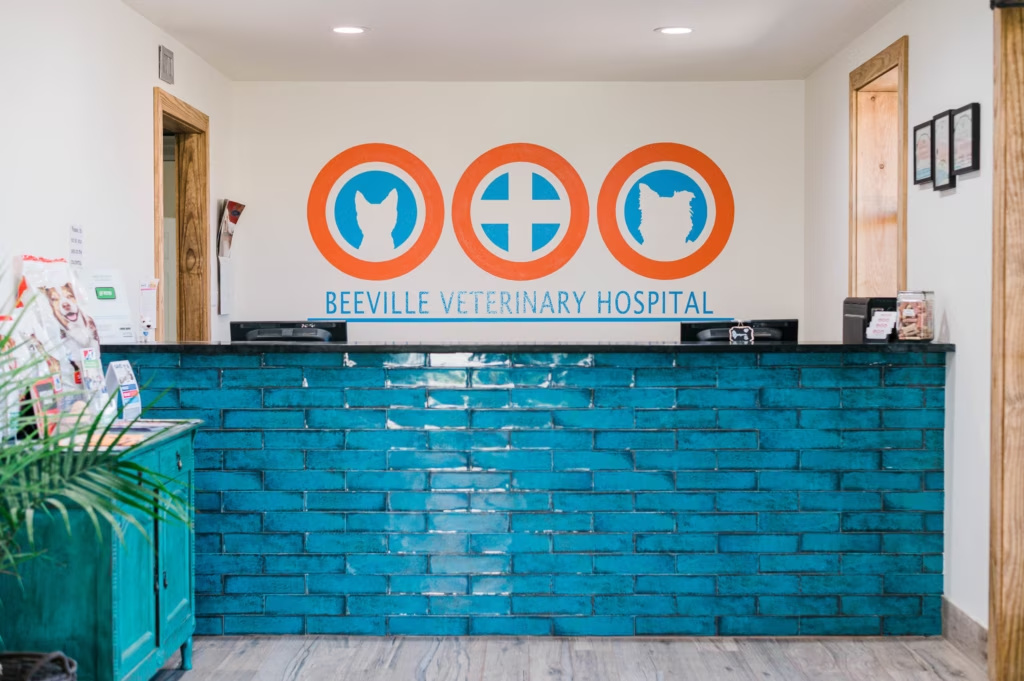
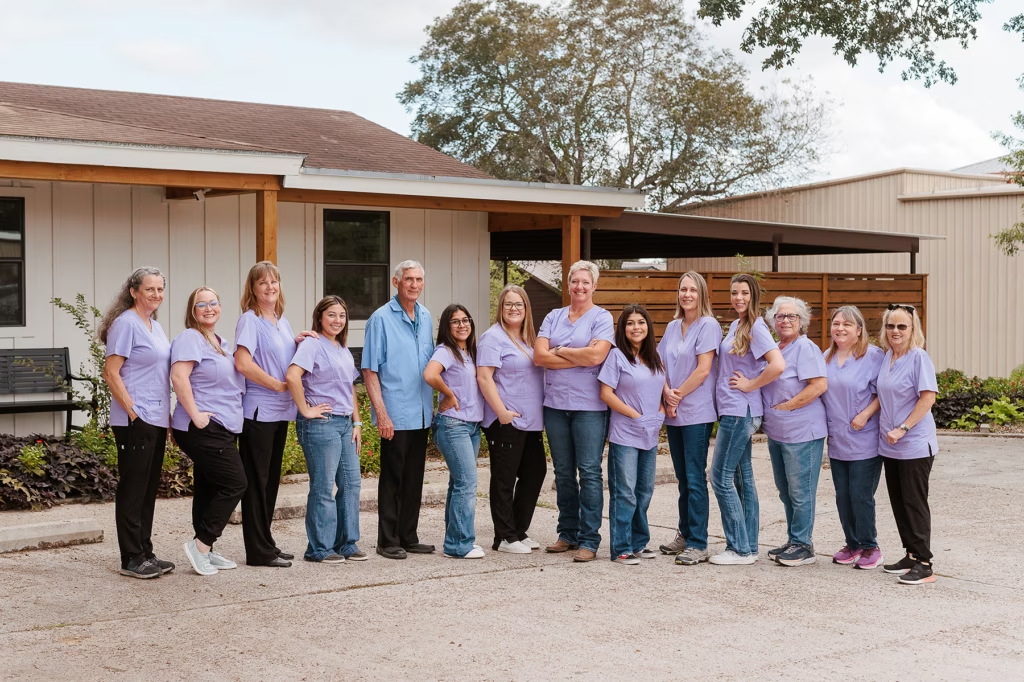
Beeville Veterinary Hospital has served the small animal community of Beeville, Texas since 1970. Dr. Rachel Hensch, a Texas A&M College of Veterinary Medicine graduate, took ownership in 2007 and has grown both the practice and its reputation for patient-centered care. Her team’s values — kindness, accountability, and a progressive approach to medicine — are not a marketing statement. They describe how the practice operates daily.
After more than a decade on Avimark, Dr. Rachel Hensch and her team at Beeville Veterinary Hospital had outgrown a system held together by physical servers, makeshift ethernet runs, and support calls just to pull a basic report. Seven months after going live on Digitail, inventory is finally under control, AI dictation has changed the game for writing SOAPs, and the team is recovering margin they had been chasing for years.
THE CHALLENGE
A 12-year-old PIMS that couldn’t scale with the practice
Beeville Veterinary Hospital had run on Avimark for more than a decade. Long-tenured staff knew every shortcode. The workflows were familiar. But familiar and functional are two different things, and by the time Dr. Hensch and Misty started exploring options, the gap had grown hard to ignore.
- Hardware was buckling. The on-premise server, weak Wi-Fi, and ethernet cables “literally just sort of attached to the walls” made every added workstation a small infrastructure project.
- Inventory was a nightmare. Too many windows, too many steps, too much information. The team had been trying for years to bring the cost of goods under control without success.
- Reporting required outside help. Pulling something as simple as “how many Chihuahuas got flea prevention?” meant calling Avimark support and asking them to write custom code to pull the report.
- Alternatives didn’t fit. Cornerstone charged per workstation — a tax on growth. Shepherd was easy to learn but, as Dr. Hensch put it, “we’re going to outgrow that in months.”
THE ACTION
Going All In: A Deliberate, Department-First Launch
When the evaluation began, Beeville considered Shepherd alongside Digitail. Shepherd was appealing: clean interface, easy to learn, zero ramp-up friction. Dr. Hensch and Misty recognized a ceiling when they saw one. “We could tell right away, we’re going to outgrow that in months,” Dr. Hensch said. Other veterinarians she spoke with confirmed it — they had chosen Shepherd and were already wishing for more capacity. Depth won.
The practice went live on Digitail in September. There was no extended parallel-run strategy. AVImark stayed accessible for three weeks as a safety net. Then Dr. Hensch and Misty called it: the backup was gone. The team was committed.
Training was split by department. CSRs focused on scheduling, check-in, and invoicing. Technicians concentrated on the clinical workflows inside the veterinary PIMS. Nobody tried to learn everything at once. As confidence built in each area, the teams began cross-training. It was a practical decision — but it made the difference between a chaotic rollout and a manageable one.
The Vetcove integration went live at launch, and the change to veterinary inventory management was immediate. What AVImark made complicated, Digitail made concrete: a unit sold is a unit subtracted. The team also shifted how they approached purchasing and reorder habits — not because they were forced to, but because the system finally made those behaviors possible to maintain.
The AI SOAP dictation reshaped how Dr. Hensch handles clinical documentation entirely. During a recent necropsy, she placed her tablet beside her, opened the SOAP, and spoke her findings aloud as she worked. The AI assistant captured each observation in real time. When the procedure was done, so was the note. No backlog. No post-close documentation. That time goes back to patients, to staff, and eventually, home.
When the practice needed a workflow Digitail didn’t yet support, Misty called in and asked. The response was not “it’s on the roadmap.” It was: we’ll build that. And the next update included it.
THE RESULTS
Five Percent in Seven Months — and a Team That Has Stopped Apologizing for Their Software
From September through April — seven months — Beeville reduced its cost of goods by 5%. Dr. Hensch is direct about the cause: the cloud-based veterinary software finally made inventory trackable in a way the team would actually use, consistently, every day.
| 5% | 3 weeks | 0 |
| Reduction in cost of goods in 7 months | From soft launch to full Digitail cutover | Server racks, workstation fees, or support tickets to write reports |
Digitail allowed Beeville to finally get a handle on inventory
With Vetcove integrated directly into Digitail, the team can see exactly what they own, what they sold, and what they need to reorder — in real time. “We’ve been trying for years and now it just is finally working,” Dr. Hensch said. The result: a 5% reduction in cost of goods between September and April.
AI scribe, working the way a vet actually works
When a patient came in for an unexpected necropsy, Dr. Hensch propped her tablet next to the table, opened a SOAP, and dictated her findings as she worked — “like the murder mystery pathologist on TV.” By the time she stepped away, her notes were already done.
A product team that ships what the clinic asks for
When the practice manager flagged a missing capability, the response was, “Hang on, we’ll make that happen.” Days later, the feature was live. “If we need it to do something, probably so do other people. And then y’all roll out your updates. That makes a big difference.”
Dr. Hensch is candid about the discomfort that comes with switching practice management software — and equally candid about the reward.
“I tell everybody: make the change. Digitail is faster, better, and writes your SOAPs for you. It’s a big deal for us. We’ve been trying for years, and now it just is finally working.”
Dr. Rachel Hensch
IMPLEMENTATION
A deliberate implementation plan to take them to the finish line
The team chose not to ease into the new system. After demoing every major option, leadership committed to Digitail and built an implementation plan that was deliberate where it counted and decisive where it had to be.
- Department-by-department training. CSRs learned the front desk first; technicians focused on the exam room. Once each group was confident, cross-training expanded across the practice.
- Three weeks of parallel operation. Avimark stayed live as a safety net for the first three weeks of go-live, then “the Band-Aid came off” and the team committed fully to Digitail.
- Honest about the human side. One long-tenured receptionist nearing retirement chose this moment to step away; another team member declined to learn the new tools. The leadership team accepted the change as part of the upgrade.
Clean slate on configuration. Rather than carrying over a dozen years of inactive Avimark items, the team rebuilt services and inventory from scratch — “super easy to do, and in hindsight what I would have done from the start.”
Key takeaways
- Ease of use is not the same as long-term fit. Beeville nearly chose the simpler option. They didn’t. If your practice is growing or has plans to grow, evaluate the ceiling of a system, not just its learning curve. The platforms that feel easiest on day one are not always the ones that serve you on year three.
- Department-sequenced onboarding reduces overwhelm. Beeville split training by role: CSRs first, then technicians, then cross-training once each team had built confidence. This approach is low-tech and replicable at any practice size. The alternative — everyone learns everything at once — is how rollouts fail.
- Inventory gains require behavior change, not just better software. The 5% cost-of-goods reduction did not happen because Digitail replaced AVImark. It happened because Dr. Hensch’s team made intentional decisions about purchasing and stock tracking once they finally had a veterinary inventory management system they could use without a manual.
Ready to see what Digitail could do for your practice? Book a demo and we’ll show you the workflows the Beeville team didn’t know to ask for.
