The Intelligent PIMS: Why Veterinary AI Has to Be Built In, Not Bolted On

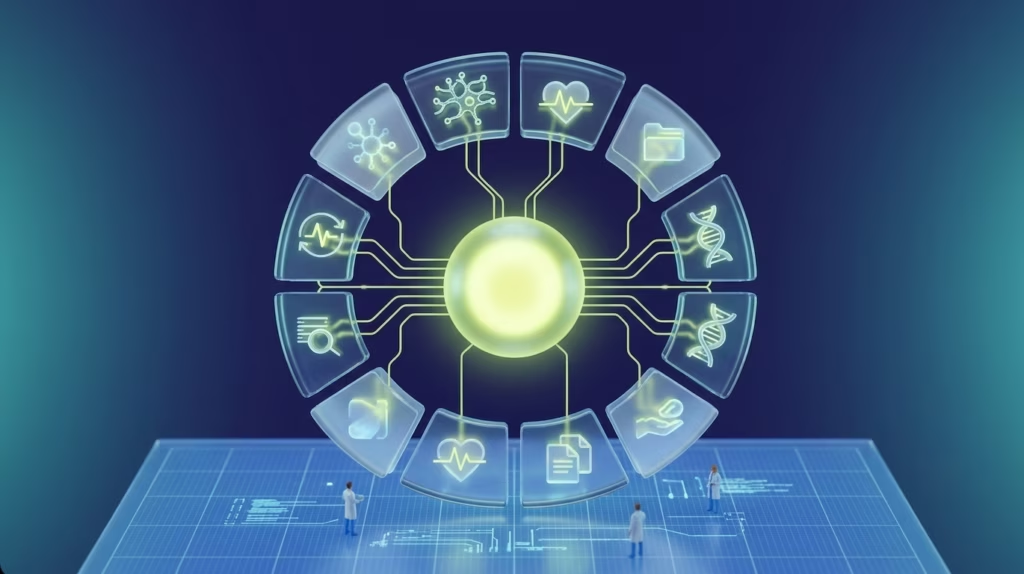
We have been building AI into Digitail since 2022. Not added on top, but built into the foundation so intelligence could move through the entire practice: the appointments, the patient data, the communications, the billing, from the start.
That is the difference between a management system with AI features and an Intelligent PIMS.
Intelligence is not a feature
Adding dictation to a record screen is a feature. It’s a useful one, and we have had it for years. But a feature does not change how a practice runs. The vet who finishes notes after dinner is not waiting on a better text box. They are waiting on software that understands the whole appointment flow, talks to the pet parent before they arrive, captures the visit while it happens, and handles the busywork after they leave.
That only works when intelligence is designed into the foundation rather than attached to the surface. An Intelligent PIMS is not a records system with an assistant bolted on. It is a platform where the patient data, the appointments, the communications, the inventory, and the billing are connected from the start, so AI can reason across all of it and act inside real workflows. Bolting on a chatbot onto a legacy database or poorly structured data does not give you that. The data was never built to flow, and the tools to connect.
In 2023, while most PIMS had no AI capability at all, we shipped the Tails AI Assistant. It summarizes patient histories, supports diagnosis and treatment planning, drafts client communications, and reads images and documents. It does so by drawing on the structured patient data already living inside Digitail, from weight history and medications to prior records and outstanding balances. The assistant gives tailored answers because the data infrastructure underneath it was built for exactly that.
We also launched Tails AI Patient Intake, an agent that runs through our mobile pet parent app and has a personalised, back-and-forth conversation with the client before the appointment based on the visit type. AI dictation and QuickSOAPs, voice-to-invoice charge capture, SOAP verification, vision-based file analysis, chat automation, and most recently the Tails AI Practice Manager.
Today there are more than twenty AI workflows embedded across Digitail, spanning every role in the building, not one screen.
Start with intake, because that is where the day begins
If you want to see what built-in intelligence looks like, start before the patient ever walks in.
Tails AI Patient Intake automatically contacts the pet parent three days before a confirmed appointment with a push notification in the app. No staff member has to pick up the phone and document the information. The agent asks about the patient and the reason for the visit, gathers additional information, checks the pet’s own history, then summarizes it all into the patient record automatically which is immediately visible for the whole team to see.
The conversation adapts to what the visit actually is. A wellness exam, a surgery, a dental, and an emergency each call for different reasoning, so the intake agent runs different rules for each visit type, right down to skipping intake entirely for sensitive appointments like euthanasia. That is not a simple form with conditional logic, it’s an agent making a judgment about a specific patient, and handing your team a head start before the room is even open.
Then untether the vet from the desk
Pair that intake with Tails VIP, the Veterinary Intelligence Partner, and the consult itself changes shape. Tails VIP is a native mobile app, including Apple Watch capabilities that puts AI scribing, automated SOAP notes, offline recording, and file analysis in your pocket, then syncs voice-recorded notes straight back into the patient record in Digitail. The vet documents while they examine, by voice, away from the keyboard, and the record is waiting for them when they sit down. The work happens once, and the software does the documentation.
AI for every role, not just the consultation room
Because the intelligence lives in the platform, it shows up wherever the work does.
The front desk leans on the assistant to draft client messages and on automatic intake to prep every arrival.
Vets get dictation, SOAP verification which checks the note for missing information and flags medical errors like allergy conflicts, voice-to-invoice that catches missed charges, and AI vision that reads a PDF or a photo in seconds.
Practice managers get the Tails AI Practice Manager, an agent with real access to your operational data that cleans up products, services, and commissions through plain conversation. Ask it to surface every service missing an AAHA code and suggest one, flag pricing that looks wrong, or copy one vet’s commission setup to another, and it does the work that used to mean a spreadsheet and a lost afternoon.
After the visit, it helps draft follow-up communications so the loop closes without the team starting from scratch.
None of these are separate products you wire together. They are one system, sharing one set of connected data, which is the whole point of an intelligent system.
The honest version of “AI-native”
Today there are many solutions on the market with the AI-native label, and it’s worth considering what this really means. AI-native is not how many AI features you can integrate with or bolt on. It is whether the data structure underneath was built so the intelligence can move through the entire practice, before the visit, during, and after, across every role. You can bolt AI onto a management system, but you cannot bolt on the foundation.
We built the foundation with intelligence in mind first, and the AI followed thoughtfully from it. That is why Digitail is not a PIMS with dictation inside. It is the Intelligent Veterinary Practice Management System, and the practices that run on one will be hard to compete with.