Hi — I’m Jamie, Director of Customer Success at Digitail.
If you’re a practice manager, owner, or DVM, you don’t need reminding how much pressure exists on a normal clinic day. Phones ringing, patients waiting, staff juggling rooms, inventory, payments, and client communication — all while trying to deliver great care and keep the day moving.
Over the past year, Digitail has grown quickly and is now supporting many more clinics across many more workflows. That growth has been exciting, but it also made one thing very clear to us: when your system needs help, support has to fit into real clinic life — not slow it down.
Since early September, we’ve been focused on strengthening how we support clinics in ways that actually matter when you’re in the middle of a busy shift.
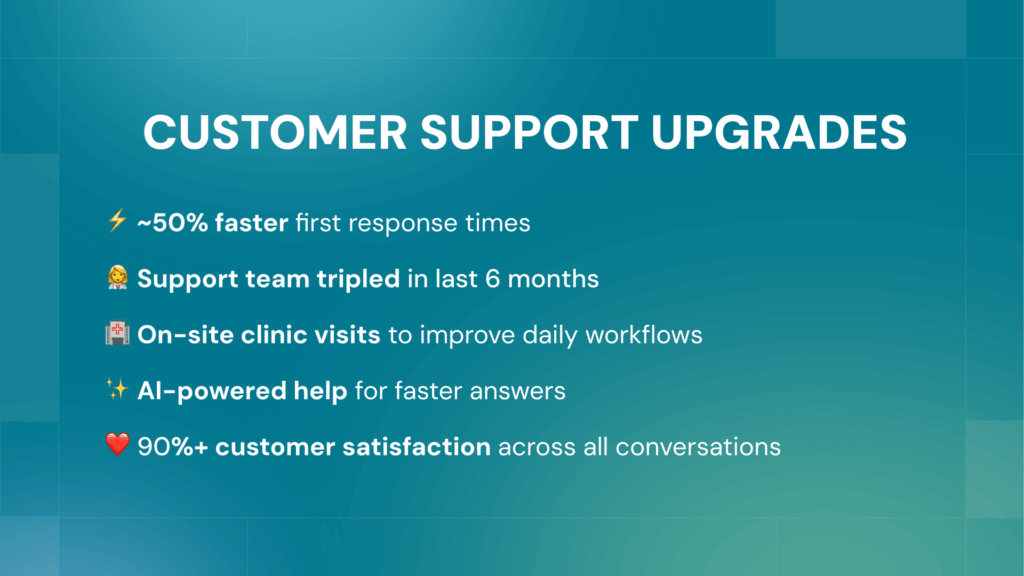
One of the first things we did was invest in the people behind support. We tripled the size of our support team, bringing on specialists with real veterinary experience — people who’ve worked in clinics and understand what it’s like when a system issue hits between appointments, during checkout, or right before closing.
We also spent time visiting clinics in person, sitting at the front desk, watching workflows live, and listening closely to what “good support” actually means when patient care can’t wait.
Here are the three improvements we focused on, and what they mean for your practice.
1. Faster response when your day is on the line
When something isn’t working — invoices won’t load, payments are stuck, a workflow feels broken — waiting hours for a response isn’t just inconvenient. It disrupts your day.
One of the clearest things we heard from practice managers and owners was that speed to first response matters, especially when you’re deciding whether to pause, workaround, or push forward.
So we focused on getting clinics to the right person faster.
By expanding the team and improving how issues are triaged, we’ve cut median first-response times by ~50% since mid-September. Even during high-volume periods, clinics are now hearing back in minutes instead of hours.
That first response isn’t just a reply — it’s reassurance. It lets you know someone understands the issue, sees the urgency, and is actively working on it, even if the full fix takes a bit longer.
What clinics are saying:
“Thank you for addressing this issue so quickly. While it didn’t impede day-to-day care, it certainly could’ve become an escalating problem.”
“Quick to respond and keeps me updated.”
2. Solving issues sooner — with less back-and-forth
Fast replies only help if problems actually get resolved.
Through clinic visits and ticket reviews, we saw how frustrating it can be to:
Re-explain the same issue multiple times
Have tickets stretch across days
Or feel like context gets lost between handoffs
So we focused on shortening the entire support journey, not just the first reply.
We introduced clearer ownership, better internal tooling, and a tiered support model so issues reach the right level of expertise faster — especially for more complex workflows.
Since early fall, median time-to-resolution is ~45% faster, with many issues now resolved within the same business day. That means fewer lingering tickets and less mental load for your team.
What clinics are saying:
“Gave exactly the information needed. Answered clarifying questions clearly.”
“We couldn’t access Digitail and couldn’t proceed with our day. The ticket was marked urgent and resolved within 30 minutes. The team kept me updated the entire time.”
3. Easier help — even when you don’t want to open a ticket
Not every question needs a conversation. Many clinics told us they prefer to self-serve when possible — as long as the answer is fast, accurate, and trustworthy.
That feedback shaped how we expanded automation and AI support.
Today, our AI agents assist with over half of all incoming conversations, quickly handling common questions so your team doesn’t have to wait — and so human specialists can focus on more complex, clinic-specific issues.
Across all support interactions, CSAT is now 87%, with clinics consistently highlighting speed, clarity, and follow-through.
Support should feel simple when it can be — and thoughtful and human when it needs to be.
What clinics are saying:
“Amazing — this has been so helpful. Thank you!”
“Fast, efficient, and helpful.”
What this means for your clinic
In practice, this means:
Faster responses when something disrupts your day
Quicker end-to-end resolution with less back-and-forth
Easier self-serve support for quick questions
Deeper, more knowledgeable help for complex workflows
This work isn’t done. We’ll continue investing in our support team, improving our tools, and spending time alongside clinics to better understand where support can be clearer, faster, and more helpful.
Your feedback directly shapes how we improve, and we’re grateful for the trust you place in us as your long-term partner.
In 2026, running a veterinary clinic feels harder than it did just a few years ago. Schedules are harder to keep full, teams are stretched thin, and every missed follow-up or unbooked appointment carries more weight. Pet owners still love their animals and want the best care for them, but many are under more financial...
Covina Animal Hospital in Southern California is known for delivering exceptional pet care. In a recent episode of the Veterinary Hospital Managers Association Manager to Manager podcast, Heidi Traylor, CVPM, PHR—practice manager at Covina Animal Hospital—shared her journey of evaluating, selecting, and implementing a new PIMS. For clinics considering a similar transition, her clinic’s approach,...
Running a high-performing clinic in 2026 isn’t just about having the latest tech; it’s about having a toolkit that protects your time, your team’s sanity, and your bottom line. Whether you’re building a new practice from scratch, planning a renovation, or just doing an honest audit of what you have, a structured equipment list helps....