You didn’t choose veterinary medicine for paperwork. You chose it to heal animals, solve complex cases, and support pet owners.
Yet here we are in 2026, and the reality looks very different. Many veterinarians today feel overwhelmed by administrative tasks—such as manual SOAP notes, endless follow-ups, and repetitive data entry. The result? Stress, exhaustion, and a profession struggling to keep balance.
Veterinary burnout is no longer a side issue. It’s one of the most pressing challenges in practice management. According to the Veterinary Wellbeing Study (Merck & AVMA, 2024), over 60% of veterinarians report high levels of exhaustion. And the top drivers are clear: staffing shortages, administrative overload, and financial pressure.
But what if the solution isn’t working harder or hiring more staff (good luck with that in today’s market)? What if it’s working smarter with technology that actually delivers on its promise to make your life easier?
AI-powered veterinary practice management is no longer science fiction. It’s happening right now in clinics across North America, and the results are transforming how veterinarians practice medicine and how they feel at the end of the day.
4 Main Drivers of Veterinary Burnout in 2026
The stress comes from multiple, compounding sources:
The Administrative Overload Medical records consume 30-40% of your workday, and that’s just the documentation. Add appointment scheduling, client communications, follow-up messages, prescription refills, insurance forms, and inventory management, and you’re spending more time on computers than with patients. For a profession built on hands-on care, this inversion feels fundamentally wrong.
Chronic Staffing Shortages Every unfilled position doesn’t just mean extra work, it means everyone operates in constant crisis mode. When you’re short of a veterinary technician or receptionist, those responsibilities don’t disappear. They land on whoever’s available, stretching already thin teams to their breaking point.
Financial Pressure With average veterinary school debt exceeding $180,000 and 60% of team members dissatisfied with compensation, financial stress compounds daily work pressures. Many professionals work second jobs, further eroding any hope of work-life balance.
Escalating Client Expectations Pet owners increasingly expect immediate responses, extended hours, and the convenience they get from every other service provider. Meeting these expectations with traditional workflows means longer days and no time to recharge.
Dr. Michelle Woodruff, founder of Woodruff Vet Services in Alberta, sees the pattern clearly after over two decades in practice:
“Our profession comes with an emotional toll, and we should take every opportunity to reduce the stress in our day.”
The True Cost of Burnout for Clinics
Burnout is personal, but it’s also operational. Veterinary clinics under pressure often see:
Reduced appointment capacity
Higher staff turnover
Missed charges and revenue leakage
Declining morale and patient care
This is where automation inside veterinary PIMS can make a measurable difference.
A Practical Look at AI in Veterinary Practice
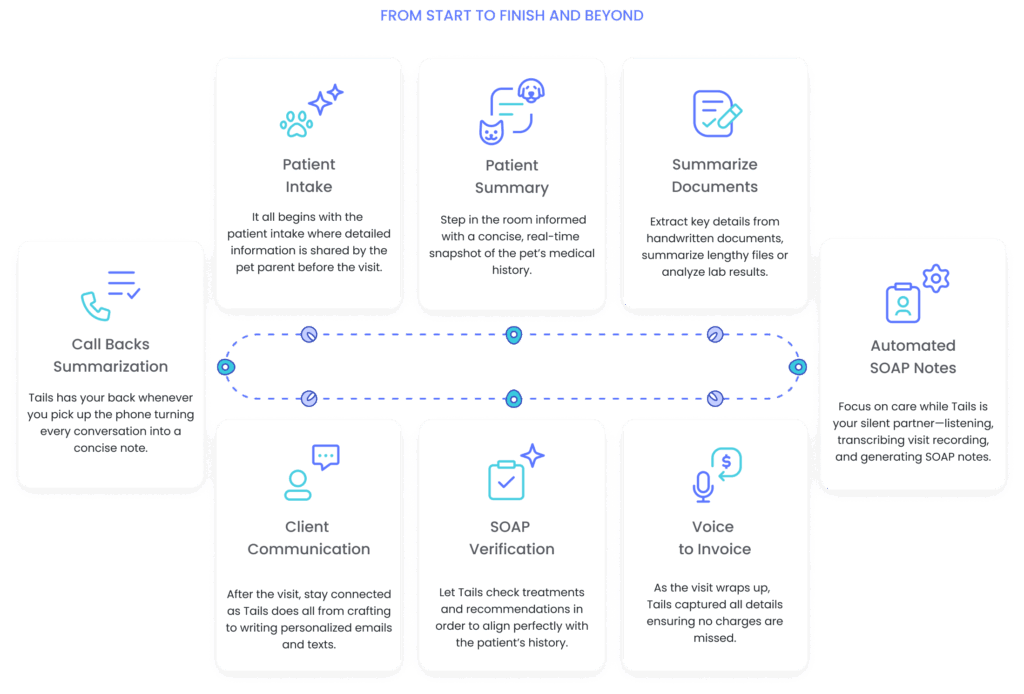
At Digitail, we developed Tails AI—a suite of tools embedded directly into your PIMS—to eliminate repetitive tasks. Here is a side-by-side comparison of how AI changes a typical day in the clinic:
Before the Appointment: AI Patient Intake
Before AI:
Client fills out clipboard forms in waiting room (often incomplete)
Receptionist manually enters data into PIMS
Total clinic time: 10-15 minutes per appointment
With AI (Tails AI Intake):
Client receives push notification 3 days before the appointment
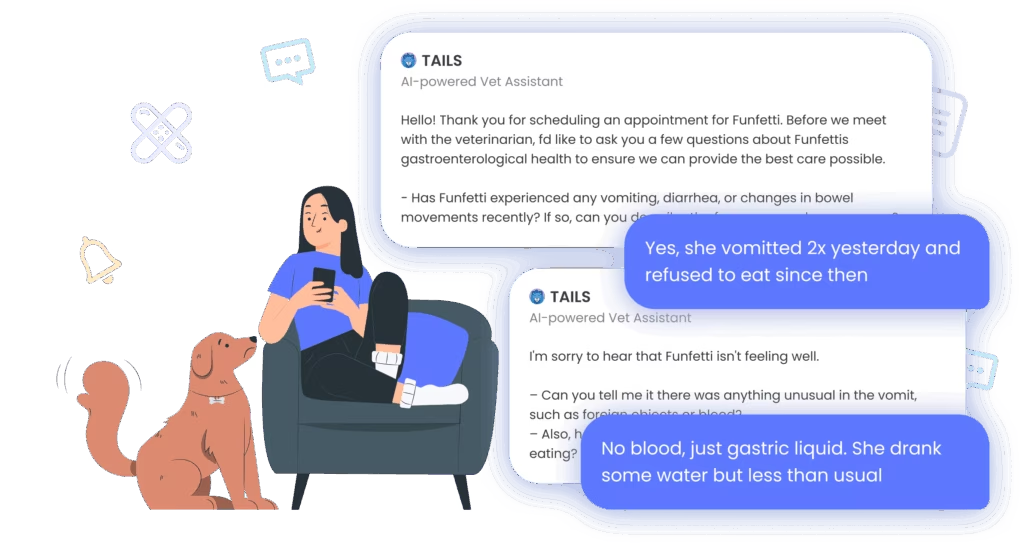
Completes digital intake via chat on their phone
AI adapts questions based on responses and patient history
Data auto-populates in appointment notes and SOAP record
Total clinic time: 0 minutes
During the Appointment: AI Dictation
Before AI:
Examine the patient while trying to remember details
Type comprehensive SOAP notes after the client leaves
Average time per note: 10-15 minutes
With AI (Tails AI Dictation):
Press the record button
Examine the patient naturally, explaining findings aloud to the client
AI transcribes, filters the conversation, and structures it into SOAP format
Review and sync to record
Total time: 2-5 minutes
Throughout the Day: Patient Summaries and Quick Reference
Before AI:
Navigate multiple screens before each appointment
Read through previous visit notes, medications, and test results
Time per review: 5-8 minutes
With AI (Tails AI Patient Summary):
Ask: “Summarize this patient’s history”
Receive a concise overview of diagnoses, medications, allergies, and recent treatments
Total time: 30 seconds
After the Appointment: Client Communication
Before AI:
Manually write discharge instructions for each patient
Customize medication details, care instructions, and follow-up plans
Time per communication: 10-20 minutes
With AI (Tails AI Assistant):
Prompt: “Create discharge instructions for post-spay care, 6-month-old Labrador”
AI generates personalized, comprehensive instructions instantly
AI generates a concise summary with key points and action items
Choose a summary tone and length
Total time: 1 minute
How Tails AI Transforms Clinic Workflows
Unlike standalone dictation apps or chatbots, Tails AI is embedded within the workflows teams already use every day. It appears exactly where it’s needed, helping teams handle repetitive work in the background, such as documenting notes, summarizing histories, drafting client communications, and managing intake.
Tails AI was designed in collaboration with practicing veterinarians, with one guiding principle: free the team from repetitive tasks so they can spend more time on patient care and less on paperwork.
3 Keys to Successful AI Implementation in Veterinary Clinic
Of course, AI is not a magic wand. While it’s a powerful tool for tackling administrative burden, successful implementation requires a thoughtful approach.
Investment and Training
There is an upfront cost in both software and the time it takes to train your team. However, clinics often find the ROI—in time saved and efficiency gained—is rapid and substantial.
Change Management
Not everyone on your team will be a tech enthusiast from day one. It’s critical to manage the transition, provide ongoing support, and clearly communicate the “why” behind the change: to make their lives easier, not to replace them.
A Piece of the Puzzle
Automation is a critical piece of the burnout puzzle, but it doesn’t solve everything. Fair compensation, positive clinic culture, and robust mental health support (like the employee assistance programs now offered by 38% of clinics) remain essential.
If you’d like to see how AI adoption looks in real life, read these stories from your peers:
If you still think AI in veterinary software is mainly about dictating SOAP notes, you’re seeing only a small fraction of what’s happening in modern veterinary practices. While automated transcription is a great first step, limiting AI to a single task is like using a cutting-edge ultrasound machine as a paperweight. Over the past few...
Learn the simple formula that transforms generic AI responses into precise, usable veterinary content. Artificial intelligence can dramatically reduce documentation time, but only if you know how to prompt it effectively. Here is the good news: Digitail’s artificial intelligence (Tails AI) already has your patient’s complete medical history, visit records, and owner information. You do...
Choosing a Practice Information Management System (PIMS) used to be about digitizing records. In 2026, with new demands for AI, seamless client communication, and workflow automation, choosing a PIMS is no longer about selecting veterinary software—it’s about partnering with a platform that will evolve with your practice. Use these key questions to evaluate potential PIMS...