Veterinary clinics are busier than ever, yet many teams still feel like they’re running on empty. What’s the culprit?
The truth is, most veterinary teams aren’t struggling because they lack dedication or skill. They’re losing hours to invisible inefficiencies that quietly compound throughout the day. These hidden time drains don’t announce themselves with alarms or error messages. They simply steal minutes here and there until suddenly, you’ve lost an entire evening with your family.
Let’s expose the five biggest culprits robbing your team of precious time and explore how modern veterinary practices are solving this problem.
1. Manual Appointment Handling
Every phone call for an appointment is a disruption. Your receptionist stops what they’re doing, picks up the phone, checks availability, writes down client information, maybe puts someone on hold to check with a tech, and finally confirms the booking. Meanwhile, two more calls are coming in, a client is waiting at the desk, and someone’s trying to find a file.
The cycle repeats dozens of times per day. Each call takes 3-5 minutes on average, but the real cost isn’t just the call itself—it’s the context switching, the interruptions to other tasks, and the mental load of managing competing priorities.
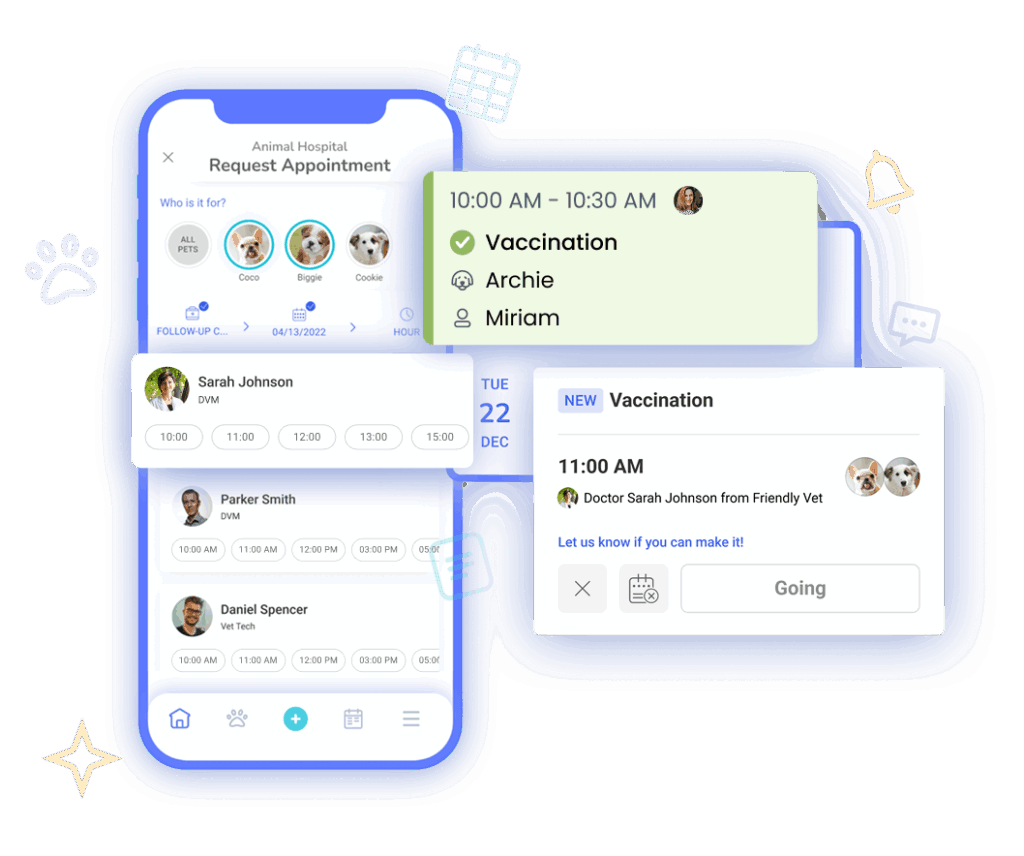
Online booking systems integrated with your practice management software allow clients to schedule appointments 24/7 without staff intervention. Vet Concierge in Frisco, TX, transformed their appointment workflow by implementing Digitail’s Pet Parent App. Dr. Taylor notes that most of their clients now book appointments directly through the app, freeing up staff to focus on in-clinic patient care. This shift helped them scale from managing 200 patients to over 400, effectively doubling their capacity without doubling their administrative burden.
Action Steps:
Enable online appointment booking with real-time availability
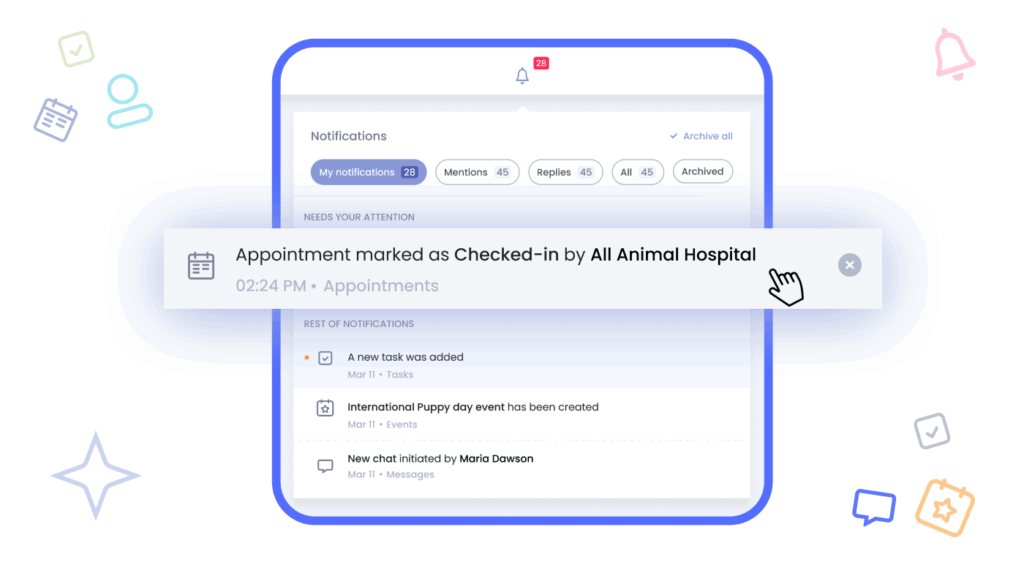
Set up automated appointment confirmations via SMS, emai or in-app push notificationsl
Create a client portal where pet parents can manage their own scheduling
Use automated waitlist management to fill cancellations instantly
2. Duplicate Data Entry
A client calls to schedule an appointment. Your receptionist writes down the information on paper or types it into a temporary note. When the client arrives, someone re-enters that information into the system. During the exam, the vet takes notes on paper or dictates to a tech who writes them down. After the appointment, someone types those handwritten notes into the patient record. When sending lab work, patient information gets entered again into the diagnostic system.
One patient visit. Four or five separate data entry points. Each one an opportunity for errors, each one consuming staff time that could be spent on patient care.
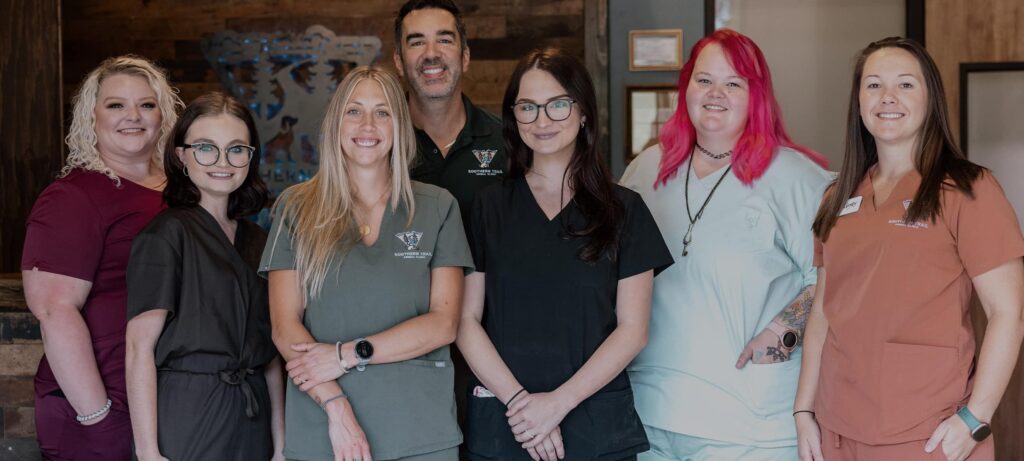
Southern Trail Animal Clinic experienced this firsthand before switching systems. As Dr. Jose Fernandez explains, their previous legacy systems required navigating multiple windows and performing repetitive data entry tasks that made running the clinic harder than it needed to be.
Studies suggest duplicate data entry adds 15-30 minutes per patient visit across the entire team. For a clinic seeing 30 patients daily, that’s 7.5-15 hours of wasted effort every single day. Over a year, that’s equivalent to losing 2-4 full-time staff members to redundant typing.
Modern cloud-based practice management systems eliminate duplicate entry through seamless integrations and single-source data input. When Southern Trail switched to Digitail, Dr. Fernandez praised the platform’s integration with IDEXX, noting that ultrasounds, X-rays, and lab results “just sync effortlessly” without requiring staff to manually transfer information between systems.
Action Steps:
Choose a practice management system with native integrations for labs, imaging, and inventory
Implement direct client-to-system data entry through intake forms
Enable bidirectional data flow between all connected systems
Train staff to enter information once, in the right place, at the right time
3. Incomplete Medical Records
7 PM on a Tuesday, and Dr. Liza Price at Riverside Vet is staring at a laptop during her daughter’s sports game, desperately trying to finish the day’s medical records. Before adopting AI-powered documentation, this was her reality and it’s the reality for thousands of veterinarians across the country.
The issue isn’t laziness or disorganization. It’s that creating thorough, accurate medical records is genuinely time-consuming. Between examining patients, educating clients, and managing the dozens of decisions required during each appointment, finding time to write detailed SOAP notes feels impossible. So records get pushed to “later,” which becomes “tonight,” which becomes “this weekend.”
The consequences extend beyond personal time. Incomplete records compromise patient care, create compliance risks, and make it difficult for other team members to understand a patient’s history.
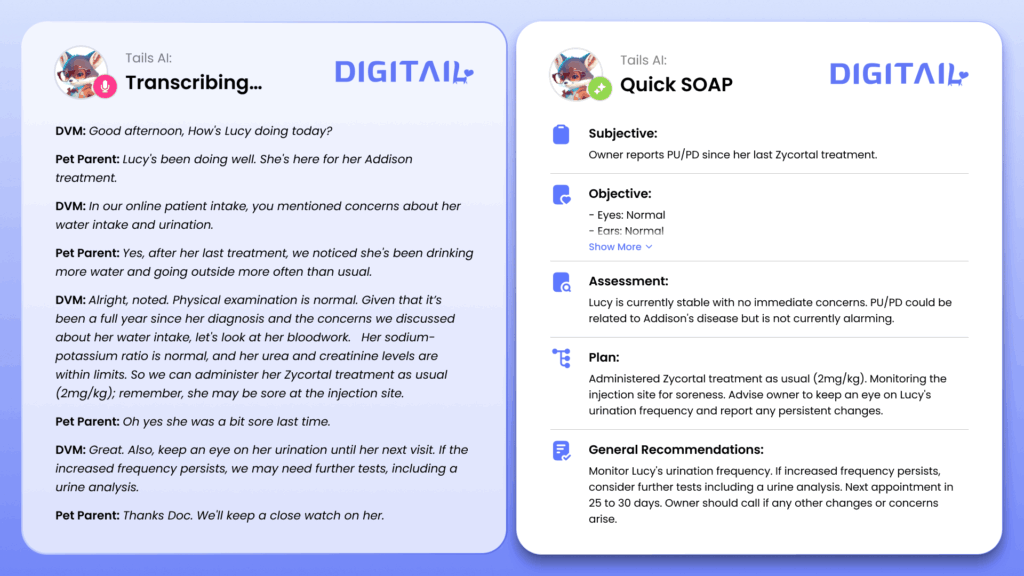
Traditional SOAP note creation takes 5-10 minutes per patient when done manually. AI-powered dictation and automated SOAP note generation have revolutionized medical record-keeping. Dr. Kristian Sorbo at Mill Brook Animal Clinic estimates that using AI dictation is approximately four times faster than typing notes manually. He describes the transformation:
I like that the transcription arrives in the SOAP format right away. No more copying and pasting or juggling multiple tabs.
The technology has evolved far beyond simple voice-to-text. Tails AI actively listens during appointments, capturing medical terminology accurately and organizing information into proper SOAP format automatically.
Action Steps:
Implement AI-powered dictation that integrates with your practice management system
Train veterinarians to dictate during or immediately after appointments
Use AI-generated templates as starting points that can be quickly customized
Enable real-time syncing so notes are available immediately to the entire team
Leverage AI for generating discharge instructions and client communications
4. No-Shows
You block out time, prepare for an appointment, maybe even pull records and prep treatment rooms. Then the client doesn’t show up. No call, no warning, just an empty slot that could have been filled by another patient.
No-shows don’t just represent lost revenue. They represent wasted preparation time, missed opportunities to help other pets, and disrupted workflow that throws off the entire day’s schedule. And when you’re already running on tight margins, every empty appointment slot hurts.
The average veterinary clinic experiences a 10-15% no-show rate. For a practice with 40 appointments per day, that’s 4-6 wasted slots daily. Beyond the appointment itself, staff spend time attempting to reach clients, rescheduling, and managing the resulting gaps in the schedule. This typically consumes an additional 30-60 minutes of administrative time per day.
Automated reminder systems dramatically reduce no-show rates while requiring zero staff effort. The most effective systems use multiple communication channels (text, email, and app notifications) to reach clients where they’re most responsive.
Digitail’s Pet Parent App, used by clinics like Southern Trail Animal Clinic, includes built-in messaging capabilities that allow direct communication between clients and the clinic. While Dr. Fernandez notes that notification settings require optimization, those clients who actively use the app remain engaged with their appointments and practice communications.
The key is making reminders automatic and multi-layered: an initial reminder a week before, a follow-up 24 hours prior, and a final confirmation on the morning of the appointment. Clients can confirm or reschedule with a single click, and if they cancel, the slot immediately becomes available for other patients.
Action Steps:
Set up automated appointment reminders via SMS, email and push notifications
Send reminders at multiple intervals: 1 week, 24 hours, and 2 hours before appointments
Enable one-click confirmation and rescheduling
Implement a waitlist system that automatically notifies clients when slots open
Track no-show patterns and reach out proactively to high-risk appointments
Consider implementing a mobile app that keeps clients connected to your practice
5. Scattered Communication
A client calls with a question. The receptionist takes a message. Someone writes it on a sticky note. The sticky note gets placed… somewhere. Maybe it reaches the vet, maybe it doesn’t. Even when messages do get through, there’s no central record of the conversation, no way to track follow-up, and no clear accountability.
This communication chaos extends to internal team coordination as well. Techs need information from vets. Vets need updates from techs. Everyone needs to know about patient status changes, scheduling updates, and urgent matters. When communication happens through a patchwork of verbal conversations, text messages, sticky notes, and scattered digital platforms, critical information falls through the cracks.
Communication inefficiencies are notoriously difficult to quantify because they’re so diffuse. However, research on workplace communication suggests that scattered, unorganized communication systems consume 1.8 hours per employee per day in duplicated efforts, clarification requests, and searching for information.
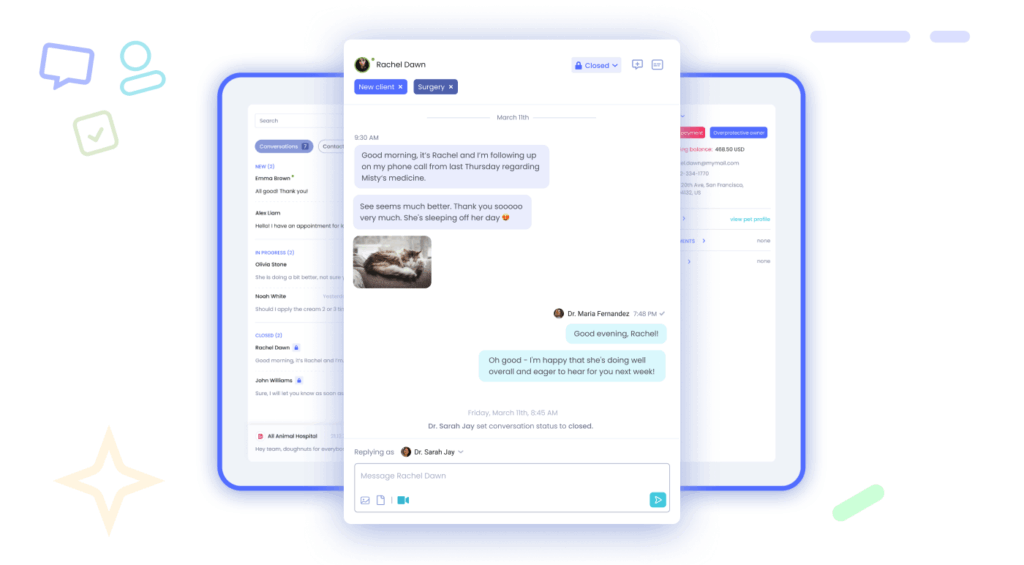
Centralized communication platforms integrated with patient records ensure that every conversation is documented, searchable, and accessible to relevant team members. Dr. Sorbo at Mill Brook Animal Clinic highlights a particularly innovative feature: smart summarization of phone calls.
“If a client calls because their dog vomited once, we might advise observation unless the issue persists,” he explains. “Now, imagine there were 15 similar calls over the past three years. Individually, they might not stand out. But with these calls and concerns summarized and logged in the patient record, it could prompt us to consider an ultrasound to check for inflammatory bowel disease.“
This demonstrates how centralized communication goes beyond mere convenience. It actively improves diagnostic capabilities and patient outcomes by preserving context that would otherwise be lost.
Action Steps:
Implement a centralized messaging system that logs all client communications
Use integrated chat features within your practice management software
Enable team collaboration tools that link directly to patient records
Set up automated workflows for common communication scenarios
Create searchable communication logs that preserve institutional knowledge
Use AI summarization to extract key information from lengthy communication threads
Addressing these time drains doesn’t require a complete practice overhaul or massive capital investment. It requires acknowledging that the way things have always been done isn’t the way they must continue to be done.
Start with one time drain. Pick the one causing the most pain in your practice. Maybe it’s the never-ending battle with incomplete records. Maybe it’s the constant interruption of appointment scheduling. Whatever it is, begin there.
Implement one solution. Give it 30 days. Measure the results. Then move to the next time drain.
The goal isn’t perfection. The goal is progress. The goal is getting home in time. The goal is reclaiming veterinary medicine as a profession centered on patient care rather than administrative burden.
A single software to achieve more with less work
Cutting-edge veterinary software for simpler operations, improved pet care, and getting home on time.
In 2026, running a veterinary clinic feels harder than it did just a few years ago. Schedules are harder to keep full, teams are stretched thin, and every missed follow-up or unbooked appointment carries more weight. Pet owners still love their animals and want the best care for them, but many are under more financial...
Covina Animal Hospital in Southern California is known for delivering exceptional pet care. In a recent episode of the Veterinary Hospital Managers Association Manager to Manager podcast, Heidi Traylor, CVPM, PHR—practice manager at Covina Animal Hospital—shared her journey of evaluating, selecting, and implementing a new PIMS. For clinics considering a similar transition, her clinic’s approach,...
Running a high-performing clinic in 2026 isn’t just about having the latest tech; it’s about having a toolkit that protects your time, your team’s sanity, and your bottom line. Whether you’re building a new practice from scratch, planning a renovation, or just doing an honest audit of what you have, a structured equipment list helps....