The Cross-Industry Pattern Veterinary Medicine Can’t Afford to Ignore
In recent years, companies across industries have added an entirely new leadership role to manage AI adoption. According to a 2025 IBM survey of over 2,300 organizations, one in four companies now have a Chief AI Officer, tasked with managing everything from tool selection to ethical oversight. Healthcare organizations are establishing AI governance committees. Banks are hiring Directors of AI Strategy. Even manufacturing plants are creating AI coordinator positions.
You might be thinking, “We’re not a human hospital or a Fortune 500 company.” You’re right. But here’s why this matters: those organizations learned the hard way that AI isn’t just another software tool you can deploy and forget. It requires dedicated oversight, continuous training, and structured governance. Veterinary clinics are facing the exact same challenges, just in a clinical context instead of a corporate one.
From AI-powered veterinary software to automated SOAP notes and AI-assisted diagnostics, clinics are adopting new tools faster than ever. But adoption without structure creates risk. Across industries, organizations have learned that AI requires governance, training, and dedicated leadership.
83% of veterinary professionals are familiar with AI tools
39% are already using them in practice
But 70% cite concerns about reliability and 43% lack proper training
The gap? No one owns AI strategy, governance, or staff enablement
The solution: Just as organizations across healthcare, finance, and technology created dedicated AI roles to manage this transformation, veterinary clinics need an “AI Coordinator” or “AI Champion” to bridge the gap between technology potential and clinical reality.
Why Veterinary Clinics Can’t Treat AI Like Just Another Software Tool
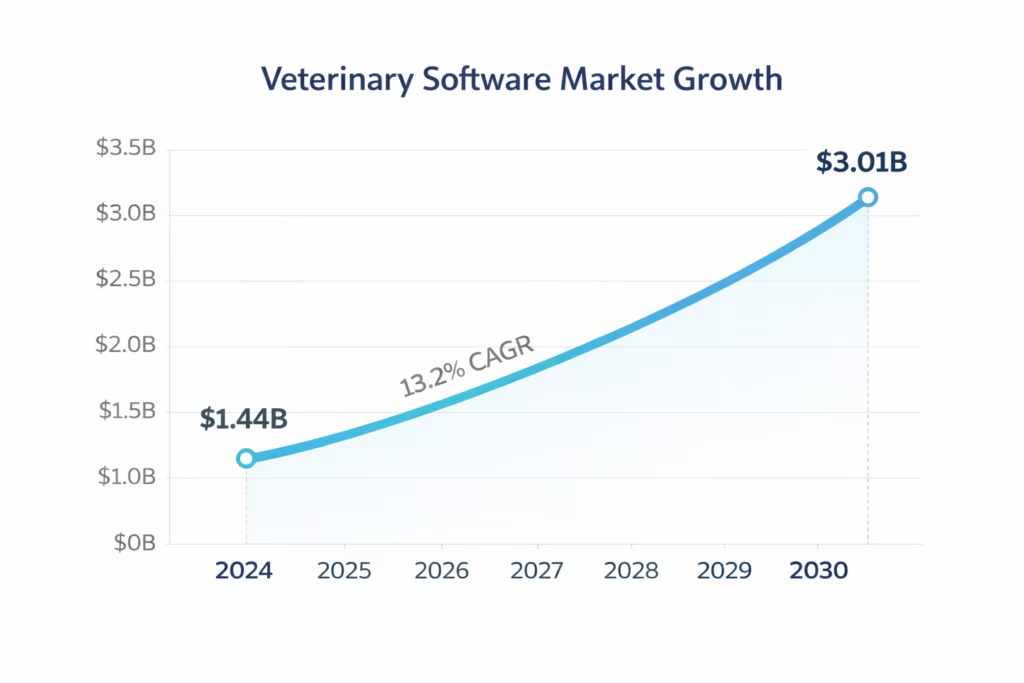
The numbers tell a compelling story. According to Grand View Research, the global veterinary software market was valued at $1.44 billion in 2024 and is expected to reach $3.01 billion by 2030, growing at 13.2% annually. This market includes practice management software, with AI increasingly being integrated for features like appointment scheduling, patient records management, billing, inventory management, and communication tools. This shows that AI will continue to get integrated in veterinary medicine.
Here’s the opportunity: while AI can transform veterinary practice operations, it delivers the best results when implemented strategically.
AI Works Best with Active Management
Traditional veterinary management software gets installed and configured once. AI-powered tools are different, and that’s actually a good thing. They improve with each release, adding new capabilities and features that can benefit your practice.
But to capture this value, someone at your clinic needs to:
Keeps up with new releasesand understands which features are worth adopting
Implements AI correctly for your specific workflows and use cases
Updates prompts and templates as best practices evolve and new capabilities become available
Tracks what’s working so you can replicate success across your team
Think of it like having a smartphone. The device gets better with each update, but you need to learn the new features and adjust your habits to get the most value. AI in veterinary practice works the same way.
The clinics seeing the strongest results from AI are those with someone actively managing adoption.
This is where a dedicated AI Coordinator role becomes essential.
The Trust Gap Is Real
The AAHA-Digitail survey revealed the challenge clearly. While familiarity with AI is high, concerns run deeper:
70% cite concerns about AI reliability and accuracy
54% have data security concerns
43% cite lack of training as a barrier
Here’s the critical insight: veterinarians who actively use AI tools daily report significantly higher confidence and optimism about integration than those who don’t. The difference isn’t the technology. It’s the support structure around it.
When your team has proper training, clear protocols, and someone to answer questions, AI adoption accelerates naturally.
Capturing AI’s Benefits While Managing Complexity
AI opens new possibilities for veterinary practices. Faster patient history analysis. Automated SOAP notes. Smarter appointment scheduling. More personalized client communication.
The clinics maximizing these benefits are those with clear answers to practical questions:
Which tasks benefit most from AI assistance?
How do we document AI-supported clinical decisions?
When should we rely on AI recommendations versus seeking additional input?
How do we ensure our entire team uses AI capabilities consistently?
These aren’t obstacles. They’re opportunities to establish best practices that make your clinic more efficient, more consistent, and better positioned for growth.
What an AI Coordinator Actually Does
An AI Coordinator isn’t a full-time data scientist. At most practices, this role starts part-time, often filled by someone who’s already tech-savvy and trusted by the team. Here’s what they actually do:
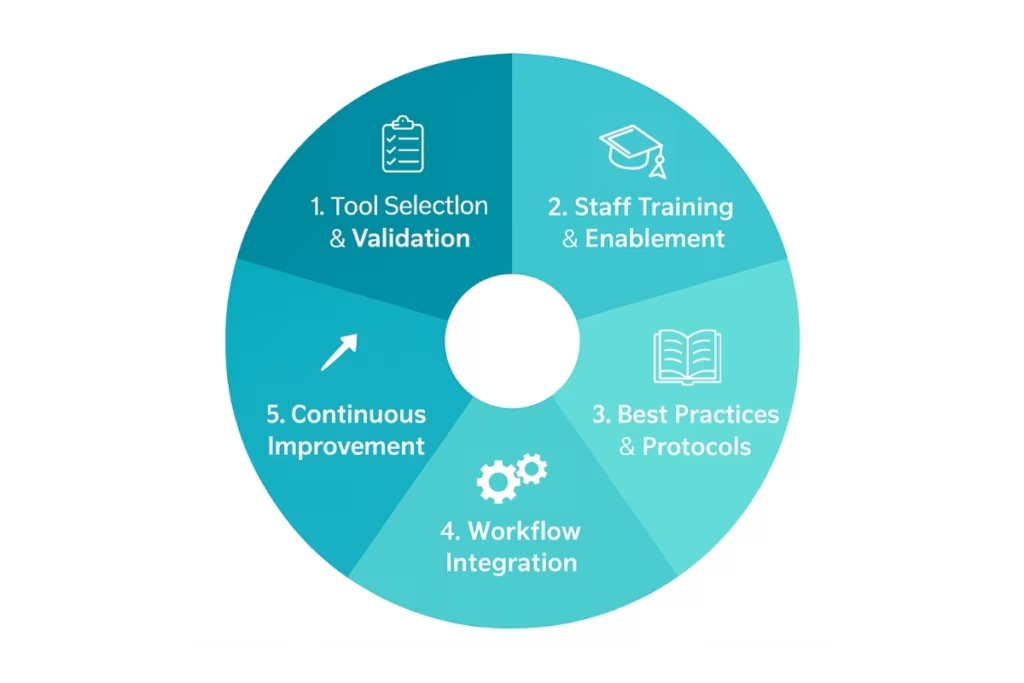
Tool Selection and Validation
Not all AI tools perform equally well. An AI Coordinator evaluates vendors against your clinic’s specific needs. They conduct internal validation before clinical deployment, testing how well tools work with your actual patient mix. They establish baseline accuracy metrics and track ongoing performance.
For example, an AI radiography tool might work brilliantly for large breed dogs but underperform on exotic animals. Your AI Coordinator identifies these gaps before they become problems.
Staff Training and Enablement
Here’s a common scenario: your clinic invests in AI-powered tools, but three months later, only a handful of staff members actually use them. Others have reverted to manual methods because they weren’t sure how the AI could help, or they tried it once and got confused.
Your AI Coordinator solves this by:
Designing role-specific training (DVMs need different knowledge than Customer Service Representatives)
Creating prompt libraries and best practice templates
Building internal champions across departments
Holding regular “AI Office Hours” sessions for questions
The AAHA survey showed that 43% of veterinary professionals cite lack of training as a barrier. An AI Coordinator makes training in veterinary clinics systematic instead of accidental.
Establishing Best Practices and Protocols
Your AI Coordinator ensures your team gets consistent, reliable results from AI tools by establishing clear guidelines:
Which clinical scenarios benefit most from AI assistance?
How do you incorporate AI insights into medical records effectively?
What’s the workflow when AI provides recommendations that need veterinary review?
How do you maintain client data security (just as you would with any digital tool)?
These protocols aren’t red tape. They’re what turn AI from “occasionally helpful” into “reliably valuable.” When everyone knows how to use AI tools the same way, you get consistent quality, faster training for new staff, and measurable improvements in efficiency.
Workflow Integration
AI tools can disrupt existing workflows if poorly implemented. Your AI Coordinator works with everyone to smooth integration, identifies friction points, and adjusts implementation based on real-world usage patterns. They measure time savings and efficiency gains, making the business case for expanded AI investment.
Continuous Improvement
AI capabilities evolve rapidly. Your coordinator stays current on new features, gathers feedback from clinical staff, communicates updates to the team, and tracks ROI. They’re your bridge between technology vendors and clinical reality.
Getting Started: Building AI Capability in Your Veterinary Business
You don’t need to hire a full-time AI specialist tomorrow. Start small and scale:
Phase 1: Designate an AI Champion (Even Part-Time)
Start with someone who’s tech-savvy and trusted by the team. Allocate 5-10 hours per week initially. Focus on auditing current AI usage and identifying gaps.
Good candidates include:
A practice manager interested in technology
A DVM who’s early-adopted digital tools
A veterinary technician with strong training skills
Phase 2: Establish Basic Governance
Document which AI tools you’re using and for what purposes. Create simple decision trees for when to use AI versus when not to. Set up tracking for AI-assisted diagnoses and outcomes. Implement basic training for all staff on existing tools.
This doesn’t require complex systems. A shared document outlining protocols gets you 80% of the way there.
Phase 3: Build Systematic Enablement
Create regular “AI Office Hours” for staff questions. Develop prompt templates for common scenarios (client communications, SOAP note assistance, appointment scheduling). Share success stories across departments. Measure adoption rates and satisfaction.
Phase 4: Scale and Optimize
As ROI becomes clear, expand the AI Coordinator role. Consider formal training or certification, allocating time to attend industry-specific webinars. Explore new AI capabilities strategically, not reactively.
For Multi-Location Practices
Designate clinic-level champions who report to a central AI lead. Standardize processes across locations while allowing customization for local needs. Share learnings and best practices across the network. Track performance variations to identify training needs.
The Future Is Structured AI Adoption
AI adoption in veterinary software is accelerating rapidly. The question isn’t whether AI will change veterinary medicine. The question is whether your clinic will manage that change intentionally or let it happen haphazardly.
Organizations across healthcare, finance, and technology learned this lesson: those who appointed dedicated AI leadership thrived. Those who treated AI as “just another tool” struggled with fragmented adoption, compliance issues, and unrealized ROI.
Veterinary medicine doesn’t need to repeat those mistakes. The AI Coordinator role, whether full-time at larger practices or part-time at smaller clinics, provides the structure to harness AI’s benefits while managing its complexity.
How Digitail Supports Responsible AI Adoption
At Digitail, we’ve built AI capabilities directly into our all-in-one veterinary practice management software. Tails AI works seamlessly across medical records, client communication, and automated workflows to help your team work more efficiently.
But technology alone isn’t enough. That’s why we’ve invested in understanding how veterinary professionals actually adopt AI, and we’re actively addressing the training and adoption challenges.
Our team is continuously working to make AI features easier to use and more reliable, while innovating with new capabilities. We’re also building comprehensive training resources to support your clinic’s AI adoption, including:
Prompt libraries with proven templates for common veterinary scenarios (coming soon)
Webinar series featuring clinics successfully using AI in practice
Real-world tips and experiences from veterinary teams who’ve made AI work for their workflows
Modern, intuitive veterinary software should make AI adoption easier, not harder. When your entire clinic operates on a single platform, AI governance becomes simpler. You have one system to train on, one set of protocols to establish, and one source of truth for measuring results.
Digitail is the all-in-one, AI-powered vet software that unifies every part of veterinary practice operations. From medical workflows and communication to payments, inventory, and insights, everything works together in one robust, scalable system built for clinics of every size.
Ready to discuss how structured AI adoption works in practice?
Book a demo with our team to explore how Digitail can help your veterinary business harness AI’s benefits responsibly and effectively.
Running a high-performing clinic in 2026 isn’t just about having the latest tech; it’s about having a toolkit that protects your time, your team’s sanity, and your bottom line. Whether you’re building a new practice from scratch, planning a renovation, or just doing an honest audit of what you have, a structured equipment list helps....
Most veterinary practice owners think about profitability in terms of appointment volume and fee schedules. Add more clients, raise prices, and see more patients per day. That math makes sense on the surface. But many clinics that increase appointment volume still struggle to improve their margins. The reason is often the same: the operational infrastructure...
The front desk at a busy veterinary clinic is one of the most demanding environments in healthcare. Phones ring, pets are anxious, pet parents have questions, and the care team needs records ready before the doctor walks in. When check-in processes are manual and disconnected, small inefficiencies compound into real problems: missed information, delayed care,...